
Contents
- Why Takino Reien Caught My Eye on Instagram
- What Takino Reien Really Is for Sapporo Locals
- The Moai Statues: Surreal, Iconic, and Unexpected
- Hill of the Buddha: A Sacred Space Designed to Be Felt
- Can Tourists Visit Takino Reien? Etiquette and Photo Manners
- How to Get There and When to Go
- Final Thoughts: A Place That Changed How I Travel
Why Takino Reien Caught My Eye on Instagram

You may have seen it while scrolling late at night.
A massive Buddha’s head emerging quietly from a snow-covered hill, surrounded by silence and white space, with towering Moai statues standing nearby as if guarding the land.
The image did not feel like a typical travel photo.
It looked almost unreal, as though someone had carefully placed art into the middle of nature, and I remember stopping to ask myself whether this scene truly existed in Japan.
Along with that excitement, a different question appeared almost immediately.
Is this actually a place that travelers are allowed to visit?
The word “cemetery” naturally brings hesitation.
You do not want to cross an invisible line, especially in a country like Japan, where respect and social awareness play a central role in everyday life.
Feeling curious and unsure at the same time is normal, and that uncertainty alone is often enough to make people give up on visiting.
I felt the same conflict.
I wanted to see the site with my own eyes, experience its quiet atmosphere, and understand why it left such a strong impression online.
At the same time, I did not want to arrive without understanding what the place truly represents.
If you are holding that same mixture of curiosity and hesitation, this guide was written for you.
What Takino Reien Really Is for Sapporo Locals

Takino Reien is not a theme park, nor was it created as a destination for photography.
It is a functioning cemetery, and for people living in Sapporo, it serves as a place of remembrance, prayer, and connection to family history.
Local families visit throughout the year, particularly during traditional memorial periods, to honor those who came before them.
That purpose has never changed, even as images of the site spread widely through social media.
So why does Takino Reien feel more open than many cemeteries abroad?
In Japan, burial grounds are often designed as calm, shared spaces rather than places meant to be hidden or avoided.
They are locations where people walk quietly, reflect, and reconnect with memories, rather than spaces separated from daily life.
Takino Reien reflects this philosophy through architecture and landscape.
Art is used not to entertain, but to guide emotions gently, encouraging visitors to slow their pace and lower their voices without being told directly.
Once you understand this background, your perspective shifts.
The site no longer feels like a strange or controversial destination.
Instead, it becomes a shared environment where visitors and locals exist together through mutual awareness and respect.
This understanding alone removes much of the initial hesitation people feel.
The Moai Statues: Surreal, Iconic, and Unexpected

For many visitors, the Moai statues are the first visual encounter upon arrival.
Standing in a long line, they immediately create a sense of contrast against the surrounding landscape.
Inspired by the Moai of Easter Island, these statues are placed here as symbolic guardians.
Rather than decoration, they represent protection and remembrance, quietly watching over the grounds.
Seeing them in person is very different from viewing them online.
Their size becomes more apparent, and the open space around them adds a feeling of stillness rather than spectacle.
It is natural to want to take photographs here.
Many visitors do, and photography itself is not discouraged.
What truly matters is the way you approach the moment.
When you remain calm, keep your voice low, and stay aware of others nearby, photography feels appropriate and unforced.
You are not performing for an audience, but simply documenting part of your journey.
That small shift in mindset often transforms nervousness into ease, allowing you to stay present instead of worrying about whether you belong.
Hill of the Buddha: A Sacred Space Designed to Be Felt

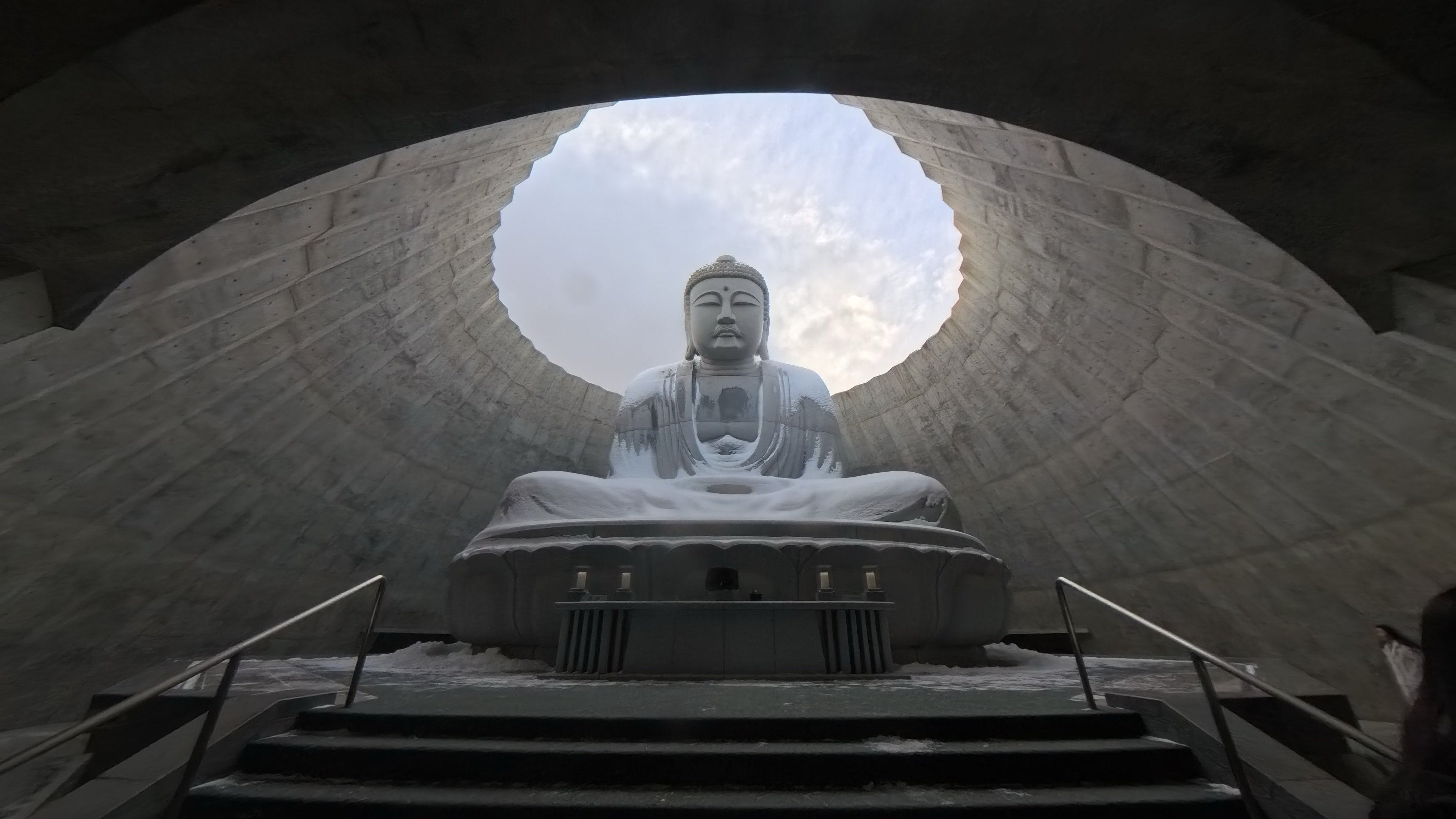
At the center of Takino Reien stands the Hill of the Buddha.
This is the iconic statue often seen online, designed so that only the Buddha’s head is visible from the outside.
The structure was designed by Tadao Ando, a Japanese architect known for creating spaces that emphasize silence, light, and movement.
Rather than overwhelming visitors, his designs encourage emotional awareness through simplicity.
As you walk toward the hill, the Buddha does not appear all at once.
It reveals itself gradually, creating a sense of anticipation that feels deliberate rather than dramatic.
Passing through the tunnel toward the statue, the atmosphere noticeably shifts.
Sounds soften, footsteps echo gently, and most visitors naturally fall silent without being asked to do so.
Inside, the full statue comes into view.
It is undeniably large, yet never flashy or imposing.
The weight of the space feels contemplative, inviting thought rather than demanding attention.
In winter, the snow transforms the experience even further.
The landscape absorbs sound and light, creating a stillness that encourages reflection.
Even visitors without religious beliefs often find themselves pausing longer than expected.
This is often the moment when people understand why Takino Reien matters.
The visit stops being about images and becomes about presence.
Can Tourists Visit Takino Reien? Etiquette and Photo Manners

Tourists are welcome at Takino Reien.
The key expectation is not expertise, but awareness.
There are no complicated rules to memorize.
What matters most is how you carry yourself within the space.
Moving slowly, speaking quietly, and remaining attentive to those around you naturally aligns your behavior with the environment.
If you notice someone praying or standing in silence, giving them space is a simple and sufficient gesture.
Photography is permitted in many areas, but attitude matters more than permission.
Avoid exaggerated poses or disruptive behavior, and approach the space as you would a memorial or church in your own country.
When visitors act with respect, something subtle but important happens.
You stop feeling like an outsider and begin to feel included in the shared calm of the place.
At that point, uncertainty fades, replaced by a quiet confidence that you are there for the right reasons.
How to Get There and When to Go
Takino Reien is located outside central Sapporo, surrounded by open land and seasonal scenery.
Reaching it requires either a combination of public transport and bus travel or access by car.
For first-time visitors, checking the route in advance removes unnecessary stress.
Understanding travel time helps you approach the visit with patience rather than urgency.
Winter visits require additional preparation.
Warm clothing, stable footwear, and flexible timing are essential, as snow can slow movement across the large grounds.
Morning to early afternoon is generally the best time to visit.
Light conditions are softer, the atmosphere feels calmer, and you avoid the pressure of rushing back before dark.
These small considerations make the experience feel practical and achievable rather than intimidating.
Final Thoughts: A Place That Changed How I Travel

Takino Reien reshaped the way I think about travel in Japan.
Not every meaningful destination announces itself loudly or competes for attention.
Some places ask visitors to slow down, observe, and reflect rather than consume experiences quickly.
They reward curiosity with understanding instead of excitement alone.
What stayed with me was not only the visual memory of the Buddha or the Moai statues.
It was the quiet satisfaction of having stepped into a place that holds genuine meaning for local people.
Visiting Takino Reien felt less like sightseeing and more like being invited into a shared space.
That experience alone made the journey worthwhile.
Leave a Reply