
Contents
- Introduction: Searching for a Shrine Beyond the Usual Tourist Path
- Understanding Kamikawa Shrine’s Role in Asahikawa’s History
- Spiritual Meaning: Deities Enshrined and What They Represent
- Visiting the Shrine in Winter: A Sensory Experience
- How to Visit Kamikawa Shrine: Practical Travel Steps
- Why Kamikawa Shrine Is Worth Including in Your Hokkaido Trip
- Final Thought
- Recent Posts
- Kagoshima: Exploring The Serene Onsen Of Kirishima
- A Vegan-Friendly Ramen Experience at Tokyo Ramen Street: Soranoiro
- A Hidden Ramen Gem in Waseda: My Visit to Shizuku
- What Is Yayoi? The Traditional Japanese Word for March Explained
- Hinamatsuri: Japan’s Beautiful Doll Festival Celebrating Girls and Spring
- Share this:
- Like this:
Introduction: Searching for a Shrine Beyond the Usual Tourist Path

When you plan a trip to Japan, visiting a shrine often feels like an obvious part of the experience, and you probably imagine red gates, lively pathways, and seasonal beauty such as cherry blossoms or autumn leaves. That image is not wrong, but if you travel further north to Hokkaido, the atmosphere can feel very different, and that difference can be surprisingly meaningful once you experience it in person.
While exploring Asahikawa, I wanted to go beyond the typical sightseeing checklist and spend time somewhere that reflected the deeper character of the region. You know how travel can sometimes become a series of photos and quick stops, and at the end of the day you realize you didn’t fully connect with the place itself. I was hoping to avoid that feeling, so I looked for a location that combined cultural meaning with a calm environment where I could slow down and observe.
That search led me to Kamikawa Shrine, a historically respected sanctuary located on a quiet hill surrounded by forest. Rather than being built for tourism, the shrine exists as part of the community’s spiritual and historical foundation, and that difference shapes the entire experience when you walk through its grounds. Visiting during winter added another layer to the encounter, because the snow softened the sounds and transformed the surroundings into a landscape that felt almost suspended in time.
If you have never visited a shrine in northern Japan, you might not know what to expect or how to appreciate the experience beyond surface-level sightseeing. In this article, I will guide you through the historical background of Kamikawa Shrine, explain its spiritual significance in approachable terms, and share realistic advice for visiting. By the time you finish reading, you should feel confident enough to decide whether this destination deserves a place in your Asahikawa itinerary.
Understanding Kamikawa Shrine’s Role in Asahikawa’s History

To appreciate Kamikawa Shrine, it helps to understand the context of Asahikawa itself, because the two are closely connected. Unlike cities with histories stretching back many centuries, Asahikawa developed relatively recently during the period when Hokkaido was being settled and infrastructure was expanding. This process involved establishing communities, transportation routes, and local institutions that would support everyday life in a challenging natural environment.
Kamikawa Shrine was founded as a spiritual center intended to protect and support the people living in the region. In simple terms, it served as a place where residents could pray for safety, stability, and success as they built their lives in unfamiliar surroundings. This origin story matters because it frames the shrine not as an attraction created for visitors, but as a site rooted in the realities of local development and communal identity.
As the city grew, the shrine itself experienced changes, including relocation to better serve the population and align with urban expansion. Rather than remaining fixed in one position, it evolved alongside the community, symbolizing the shared journey between place and people. Understanding this dynamic relationship can enrich your visit, because you are not just seeing architecture or ritual space, but stepping into a living historical narrative that continues today.
For travelers, recognizing this background shifts perspective from passive observation to engaged exploration. Instead of wondering what to photograph next, you may find yourself thinking about how cultural institutions help communities navigate uncertainty and change. That shift in mindset often deepens the value of a visit and makes it easier to remember long after you leave.
Spiritual Meaning: Deities Enshrined and What They Represent

For many international visitors, religious terminology can feel intimidating or confusing, especially when encountering unfamiliar traditions. Fortunately, you do not need specialized knowledge to appreciate the spiritual dimension of Kamikawa Shrine, and approaching it with curiosity rather than expertise is perfectly sufficient.
The shrine enshrines several important deities from Japanese mythology, each associated with ideas that are relatively easy to grasp when explained simply. One represents light and order, another is connected with land and relationships, and another relates to knowledge and cooperation. You can think of them not as distant abstract figures, but as symbolic reflections of values that communities wish to cultivate in daily life.
Even if you do not personally follow Shinto practices, visiting such a place can still be meaningful as a cultural experience. Observing the layout, architecture, and quiet routines allows you to engage with how spirituality intersects with environment and tradition in Japan. This engagement does not require belief or participation; respectful awareness alone creates connection.
When you approach the shrine with this mindset, small details often become more interesting. The placement of structures, the pathways guiding your movement, and the rhythm of the space all contribute to an atmosphere designed to encourage reflection. Rather than analyzing these elements academically, simply noticing them can make your visit more immersive and rewarding.
Visiting the Shrine in Winter: A Sensory Experience

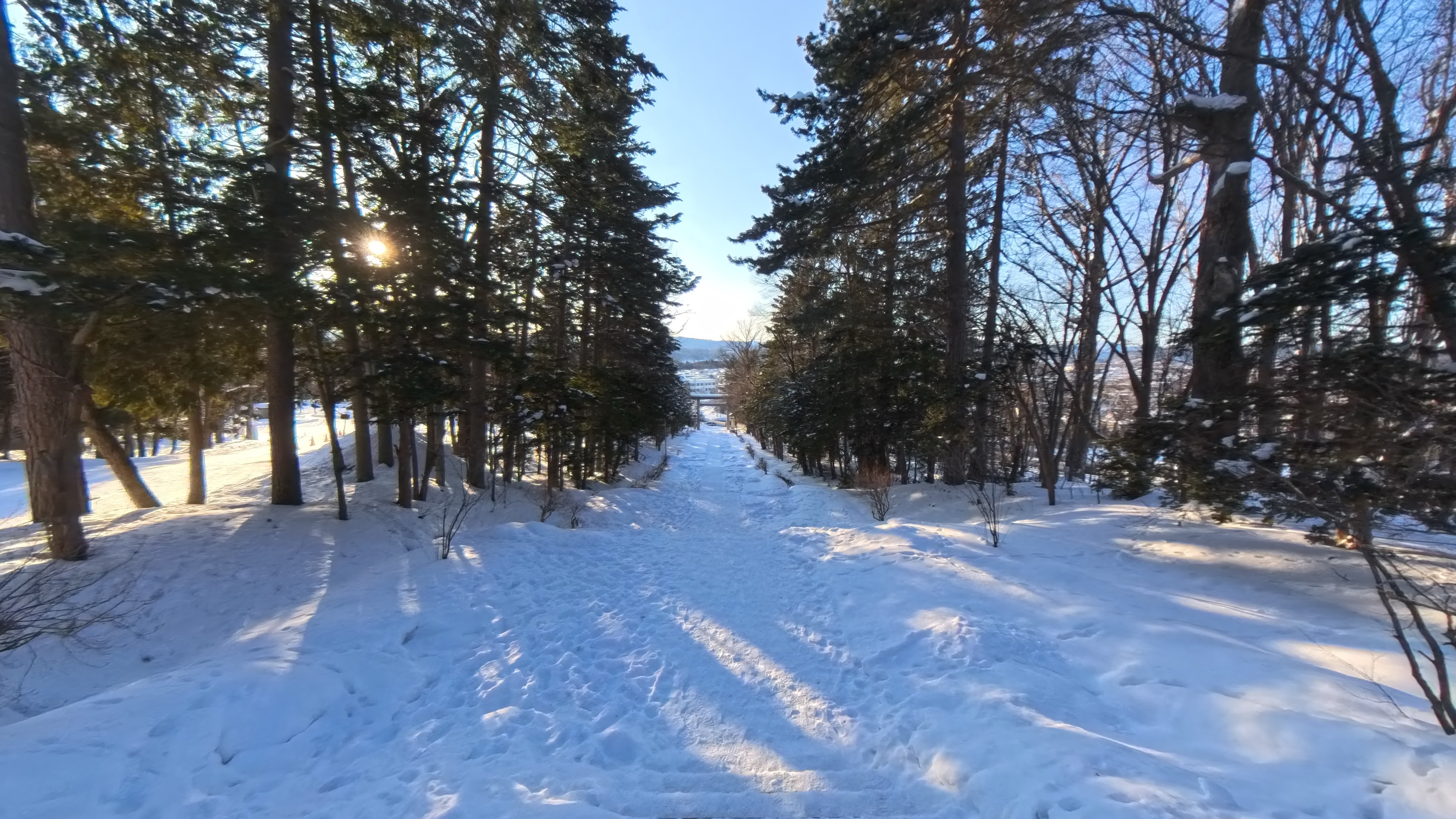
Winter transforms Kamikawa Shrine into something especially memorable, and if you have the opportunity to visit during snowy months, you may discover that the season enhances your perception of the environment in subtle ways. Walking toward the grounds, you pass through wooded surroundings where the air feels crisp and the sound of footsteps becomes part of the atmosphere itself.
Snow alters how you experience space, because it softens noise and simplifies visual contrast, allowing architectural forms and natural textures to stand out clearly. As you move deeper into the site, you might notice how the quiet encourages slower pacing, and that slower pace often leads to more attentive observation. You begin to see details you might otherwise overlook, such as how light reflects on surfaces or how branches frame pathways.
Of course, enjoying winter scenery also requires practical awareness. Wearing appropriate layers, choosing stable footwear, and planning manageable walking time help ensure comfort throughout your visit. These small preparations allow you to focus on appreciation rather than distraction, which ultimately enhances the experience.
Spending time in this environment can feel refreshing, not because of dramatic events, but because of the combination of calmness and perspective it provides. Standing in a place shaped by nature and tradition, you may find yourself thinking about travel differently, seeing it as participation rather than consumption.
How to Visit Kamikawa Shrine: Practical Travel Steps

From a logistical standpoint, incorporating Kamikawa Shrine into your itinerary is straightforward, which makes it accessible even if your schedule in Asahikawa is limited. The shrine is located within reasonable distance from the city center, and reaching it typically involves a short ride followed by a manageable walk through park-like surroundings.
Planning your timing thoughtfully can make a difference. Morning visits often provide quiet conditions and softer lighting, while winter afternoons offer gentle contrasts that photographers may appreciate. Considering your personal priorities, whether reflection or visual capture, can guide your decision.
Combining the visit with nearby attractions is another realistic approach, especially if you prefer efficient travel days. Treating the shrine as one component of a broader exploration ensures you gain both cultural depth and variety without feeling rushed or overwhelmed.
By thinking through transportation, timing, and pacing in advance, you reduce uncertainty and free yourself to focus on experiencing the location. This preparation aligns well with travel habits that emphasize intention over spontaneity, leading to more satisfying outcomes.
Why Kamikawa Shrine Is Worth Including in Your Hokkaido Trip
Travel decisions often involve weighing options, and you might wonder whether adding another destination truly enhances your journey. Kamikawa Shrine offers value not because of spectacle, but because of contrast, giving you an experience distinct from urban sightseeing or entertainment-focused stops.
Engaging with a culturally grounded environment encourages reflection, and that reflective dimension can balance the excitement of other activities. Rather than filling every hour with stimulation, moments of quiet observation help maintain energy and perspective throughout your trip.
Certain travelers may resonate particularly strongly with such locations, especially those interested in photography, cultural understanding, or contemplative spaces. However, even casual visitors can benefit from stepping into unfamiliar environments that invite slower awareness.
Ultimately, including Kamikawa Shrine allows your itinerary to represent multiple facets of travel, combining activity with atmosphere. This balance often leads to richer memories and more meaningful storytelling when you reflect on your experiences later.
Final Thought

Kamikawa Shrine is not defined by dramatic spectacle or overwhelming scale, yet its significance emerges through history, environment, and emotional resonance. Visiting allows you to encounter a side of Japan shaped by development, resilience, and continuity, offering insight beyond what guidebooks alone can provide.
As you consider your own travel planning, remember that meaningful experiences often arise from thoughtful selection rather than quantity of destinations. Choosing places that encourage presence and understanding can transform your journey from observation into participation.
If you are unsure where to begin, today’s first step is simple: open your travel planning notes and write down Kamikawa Shrine as a candidate stop in your Asahikawa schedule. Taking that small action turns curiosity into intention, and intention is where memorable travel experiences truly begin.


Leave a Reply