

In this part, I’d like to introduce some sightseeing spots for you. When I visit Kamakura, I go there every time. As you know, Kamakura has a lot of famous spots so, I can’t share all of them. So, I share my favorite places.
1. Enkaku Temple(円覚寺)

Enkaku Temple is located a front of Kita-Kamakura station. Once you get of the station, you can see at first. Actually, here is my most favorite place in Kamakura. When you go into this temple, the atmosphere is so calm that you feel relax and forget your bad feeling everything.

Engakuji, one of Japan’s most significant Zen Buddhist temples, has a rich and storied history that dates back to the Kamakura period (1185-1333). Founded in 1282 by Hojo Tokimune, the eighth regent of the Kamakura shogunate, Engakuji was established to honor the fallen soldiers on both sides of the Mongol invasions.
Throughout its history, Engakuji has been closely associated with the samurai class, who played a crucial role in the development and patronage of the temple. It served as a center for Zen Buddhism, attracting many practitioners and scholars seeking enlightenment.


During the Muromachi period (1336-1573), Engakuji experienced periods of prosperity and decline, but it managed to survive various challenges, including fires and political upheavals. In the Edo period (1603-1868), the temple was rebuilt and expanded with the support of the Tokugawa shogunate, further solidifying its status as a prominent religious institution.
Engakuji’s significance continued into the modern era, as it played a role in the revival of Zen Buddhism during the Meiji Restoration (1868-1912) and subsequent periods of cultural reformation in Japan.
Today, Engakuji stands as a testament to Japan’s rich religious and cultural heritage, attracting visitors from around the world with its tranquil atmosphere, historic architecture, and beautifully landscaped gardens. It remains an active center of Zen practice and a symbol of spiritual enlightenment for generations to come.

That’s me surrounding many little Buddha statue.

In this garden of the temple, there is a narrow stairs to go to a top of this temple. Each height are a little bit high so it was a little bit tough for me. Anyway, once you go there, there is my favorite view in Kamakura.


Have a look. Such a nice view isn’t it? To be honest, when I was a kid, trees were short so the view in a past was better than now.
Also, there is a small cafe, and they offer Macha.


In conclusion, Enkaku-ji Temple is very tranquility place so you can feel relax, calm, and Zen. Historically, and from the point of Japanese culture, Enkaku-ji Temple is very important place. Here is so interesting place so, I highly recommend you to visit there!
Opening hour: 8:30am-4:30pm
Fee: Adult: 500 yen, Child: 200 yen
2. Hase Temple(長谷寺)

Here is Hase Temple, which is located close to Hase station: Enoshima Dentetsu line. To put it simply, here is a Japanese garden. Of course, there is temples but more over, it’s famous for flowers in this garden. Unfortunately, I visited Kamakura last March, first week so it was still cold and flowers had not started bloom.


Hasedera, also known as Hase-dera, is a renowned Buddhist temple located in Kamakura, Kanagawa Prefecture, Japan. Its history dates back over 1,300 years, making it one of the oldest temples in the region.
According to legend, Hasedera was established in 736 AD by the monk Tokudo Shonin, who discovered a large camphor tree in the area containing a carved image of the eleven-headed Kannon Bodhisattva. This discovery led to the founding of the temple, which became known as a place of worship dedicated to Kannon, the Buddhist deity of mercy and compassion.
Throughout its long history, Hasedera has undergone several reconstructions and expansions due to natural disasters such as fires and earthquakes. However, it has persevered and remains a significant religious and cultural landmark in Kamakura.


The temple complex is famous for its stunning architecture, including the main hall (Kannon-dō) which houses the famous wooden statue of the eleven-headed Kannon, standing at around nine meters tall. The temple grounds also feature beautiful gardens, pagodas, and other structures that add to its serene ambiance and historical charm.
Today, Hasedera continues to attract visitors from all over Japan and around the world, who come to admire its cultural treasures, seek spiritual solace, and enjoy the scenic beauty of its surroundings. It stands as a testament to the enduring legacy of Buddhism in Japan and serves as a symbol of peace and enlightenment for generations to come.

In the east side of temple, there is a Benten-sama’s cave. Benten-sama is one of a Seven Lucky God. Benten-sama gives you a fortune of Music, Study, Money, Entertainment, and Beauty. If you are student or entertainer, and if you wanna earn enough money, and become more beautiful, you’ll grab your will visiting this cave.


Some people say Hasedera is a Paradise in west side of Kamakura. As I said, here is famous for a garden. In winter, it’s a little bit monotonous but through year, flowers keep blooming. Also, many Benten-sama and Buddha statues are welcoming to you. Please enjoy your exploration in this Temple, Kamakura!
Opening hour: 8:00am-4:30pm
Fee: Adult: 400 yen, Child: 200 yen
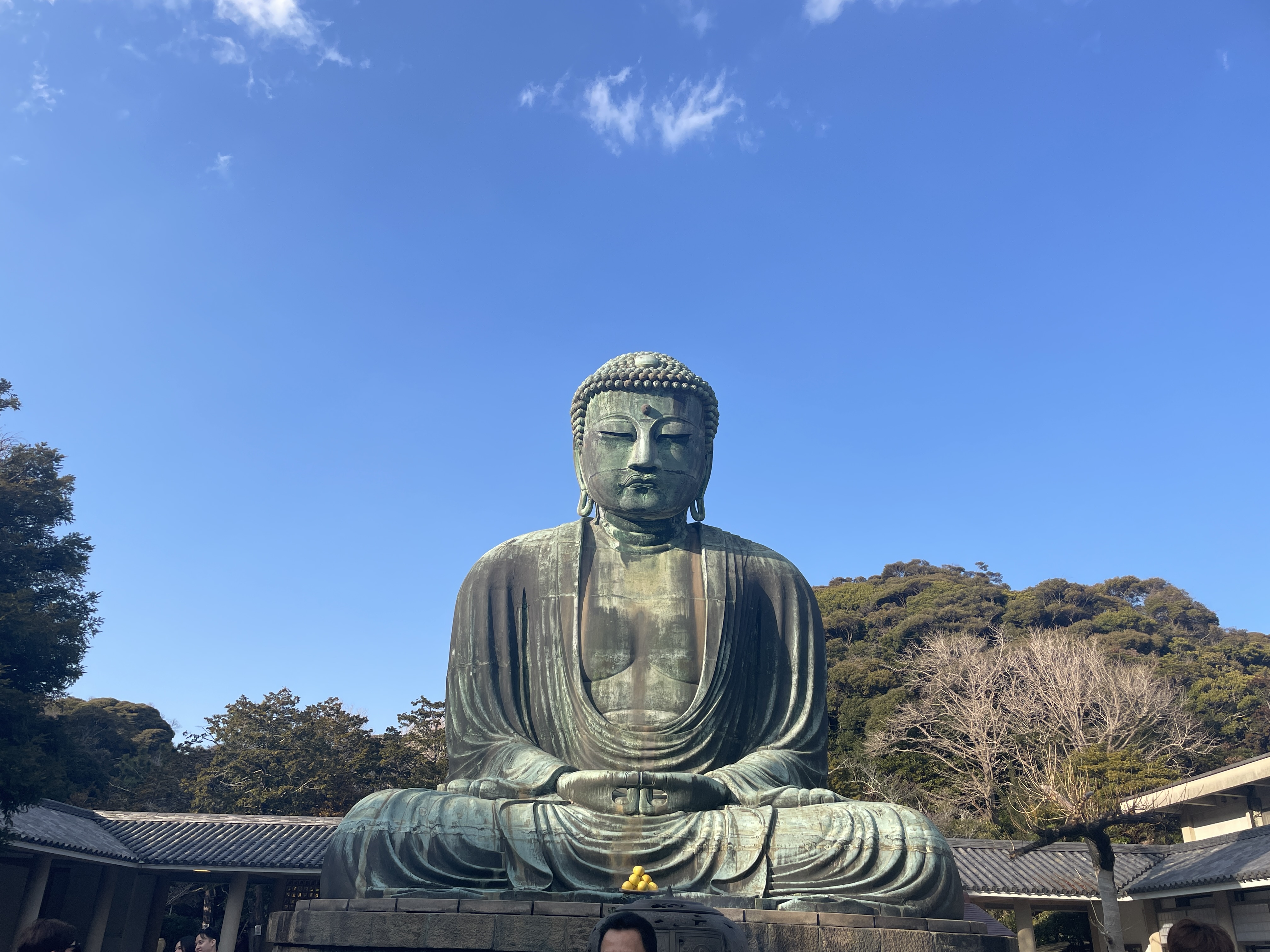
3. Kotoku-in: Kamakura Daibutsu(高徳院:鎌倉大仏)

Have you ever seen this Big Buddha statue? I think you might see an advertisement of tour in Japan.
Here is Kotoku-in: Kamakura Daibutsu and it’s a special pronoun of Kamakura. When I visited there, many visitors were visiting and most of them were from another countries. They took many photos in front of the statue.

Kotoku-in, also known as the Great Buddha of Kamakura, is a historic Buddhist temple located in Kamakura, Kanagawa Prefecture, Japan. The temple is renowned for its monumental outdoor bronze statue of Amitabha Buddha, which stands at approximately 13.35 meters (44 feet) tall and weighs around 121 tons.
Kotoku-in was originally established in 1252 during the Kamakura period, a time characterized by the rise of the Kamakura shogunate and the spread of Buddhism in Japan. The Great Buddha statue was likely erected shortly after the temple’s founding, although the exact date of its construction remains uncertain. The statue is believed to have been cast in bronze by local artisans using traditional techniques.
Throughout its history, Kotoku-in has faced numerous challenges, including natural disasters, fires, and periods of neglect. Despite these difficulties, the Great Buddha has remained a symbol of resilience and spiritual significance for both locals and visitors alike.
Over the centuries, Kotoku-in has undergone several renovations and restorations to preserve the statue and maintain the temple grounds. Today, it stands as a symbol of Japan’s cultural and religious heritage, attracting tourists and pilgrims from around the world.
In addition to the Great Buddha statue, Kotoku-in features other notable structures, including the temple’s main hall, known as the Amida-do, which houses a smaller statue of Amida Buddha. The temple’s serene surroundings and historical significance make it a popular destination for those seeking to explore Japan’s rich cultural legacy.

HP of Kotokuin, Kamakura Daibutsu
Opening hour: 8:00am-5:00pm
Fee: Adult: 300 yen, Child: 150 yen
4. Tsurugaoka Hachimangu(鶴岡八幡宮)

Here is Tsurugaoka Hachimangu. It’s also a landmark of Kamakura and a pronoun of Kamakura! It’s the most famous sightseeing spot in Kamakura I think. In a textbook of history, this picture is definitely on it, so among student from elementary school student and high school student, Kamakura is this place.

Tsurugaoka Hachimangu is a prominent Shinto shrine located in Kamakura, Kanagawa Prefecture, Japan. Its history dates back to the late 12th century when Minamoto no Yoritomo found the shrine, the founder and first shogun of the Kamakura shogunate.
Yoritomo established Tsurugaoka Hachimangu in 1180 as the tutelary shrine of the Minamoto clan and dedicated it to Hachiman, the god of war and patron deity of the samurai. The shrine was strategically located atop a hill overlooking the city, symbolizing the authority and power of the shogunate.


Throughout its history, Tsurugaoka Hachimangu has been closely associated with the Kamakura shogunate. Also, it played a significant role in the political and religious affairs of the time. It served as a center for both Shinto rituals and Buddhist ceremonies, reflecting the syncretic nature of Japanese religious practice during the medieval period.
The shrine underwent several renovations and expansions over the centuries, with many of its current structures dating back to the Edo period (1603-1868). These include the iconic red torii gate, the main hall (honden), and the Maiden, a long approach lined with cherry trees.
Today, Tsurugaoka Hachimangu remains one of Kamakura’s most important religious and cultural landmarks, attracting visitors from all over Japan and around the world. Its picturesque setting, rich history, and vibrant festivals continue to make it a popular destination for tourists, worshippers, and locals alike.

From the top, and I visited there around 5pm. Sun set and Kamakura city was very beautiful. Of course, I bought some souvenirs. That’s a little charm which is a motif of my Chinese zodiac (my Chinese zodiac is dragon.)
In the field of Tsurugaoka Hachimangu, totally, Kamakura trip takes a lot of time to experience everything.
When I just walk around a field of shrine and temple, it takes about a hour and half. Especially, I like studying Kamakura period. That’s why, when I visit here, I always think I need more time to trip.
That’s the end of this part. As I said, Kamakura has too many sightseeing spots. I shared only 4 places. Next Kamakura’s part, I’d like to share streets to buy souvenirs and street foods and food shops where I visited. Don’t miss it!
If you’re interested in Kamakura and you’ve already visited there, please leave your comment and share your experience!!!
Leave a Reply