
Contents
- Why Ehomaki Feels Confusing at First on 3rd February?
- What Is Ehomaki?
- Why Direction Matters: The Idea Behind Ehomaki
- Where Did Ehomaki Come From?
- What’s Inside an Ehomaki?
- How to Eat Ehomaki: A Simple Step-by-Step Guide
- Final Thoughts: If You Visit Japan in February, Give It a Try
- Recent Posts
- Kagoshima: Exploring The Serene Onsen Of Kirishima
- Hidden Gems in Nakameguro: A Tiny Mexican Spot Locals Love After Dark
- Nakameguro’s Best Kept Secret: Wagyu Dining by the River
- Nakameguro Cherry Blossoms: Complete Guide to Meguro River Sakur
- Cherry Blossom Season in Japan: When Does Sakura Really Start?
- Share this:
- Like this:
Why Ehomaki Feels Confusing at First on 3rd February?
If you have heard about Ehomaki before, you probably have a vague image in your mind: a thick sushi roll, eaten in February, while facing a specific direction.
But when you actually try to understand it, things start to feel a little confusing, don’t they?
People mention “Setsubun,” lucky directions, and the idea of eating in silence, often without explaining how these pieces fit together. On top of that, Ehomaki looks like sushi, yet you are told not to cut it, which goes against what many people associate with sharing food. If you are visiting Japan, you might even wonder whether doing it “wrong” would be rude.
This kind of hesitation is very common, especially for travelers who already enjoy Japanese food and want to respect the culture, but do not want to feel pressured by complicated rules. The good news is that Ehomaki is not a strict ritual meant to test your knowledge. It is a seasonal custom that most Japanese people enjoy in a relaxed way.
Once you understand the idea behind it, Ehomaki becomes much easier to approach. Instead of asking, “Am I doing this correctly?” you can start thinking, “This looks fun, I can try this.” That small shift is exactly what this guide is here to help you with.
What Is Ehomaki?
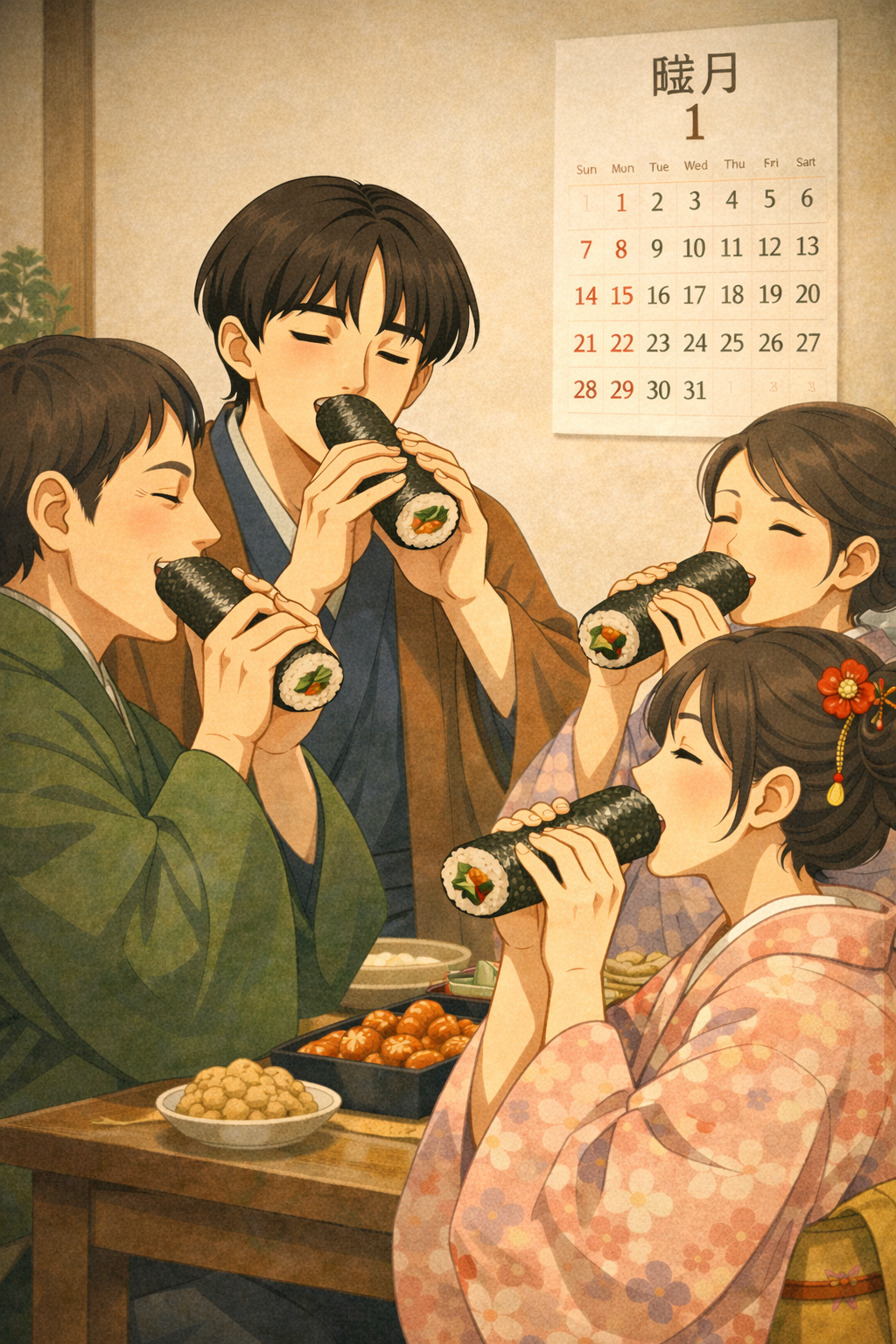
Ehomaki is a thick sushi roll traditionally eaten around February 3rd, during a seasonal event called Setsubun, which marks the transition from winter to spring in Japan. The word “Eho” means “lucky direction,” and “maki” simply refers to a rolled sushi.
Unlike the small sushi rolls you might see at a sushi restaurant, Ehomaki is larger and filled with multiple ingredients. It is meant to be eaten as one long roll while facing the lucky direction of that year. People often make a wish in their mind while eating it, treating the moment as a simple way to welcome good fortune for the coming months.
One important thing to know is that Ehomaki is not a luxury dish or a rare tradition practiced by only a few people. In modern Japan, it is very accessible. You can find it easily in supermarkets, convenience stores, and sometimes even bakeries offering their own creative versions.

This everyday feeling is part of what makes Ehomaki interesting. It sits at the intersection of food, seasonality, and casual belief, rather than formal ceremony. You do not need special tools, special knowledge, or perfect timing to take part in it.
When Do People Eat Ehomaki?
Ehomaki is eaten on or around February 3rd, which usually corresponds to Setsubun. Some years, the date shifts slightly, but most people simply remember it as “early February.” Stores start selling Ehomaki a few days in advance, making it easy to notice even if you are not actively looking for it.
Why Direction Matters: The Idea Behind Ehomaki

The idea of facing a specific direction comes from an old way of thinking that was influenced by ancient Chinese philosophy. In simple terms, it suggests that each year has a direction associated with good fortune. By facing that direction while eating Ehomaki, you symbolically align yourself with positive energy for the year ahead.
This might sound serious at first, but in practice, it is treated very lightly. Many people quickly check the lucky direction on their phone, turn their body or face slightly, and start eating. The action itself matters more than absolute accuracy.
You might also hear that people eat Ehomaki in silence. This is said to help you focus on your wish, so it does not “escape” through words. Again, this is more about intention than strict behavior. If you laugh halfway through or talk a little, no one will judge you.
Do You Have to Be Perfect?
The short answer is no. Even in Japan, many people do not follow every detail exactly. Some people cut the roll, some forget the direction, and others simply enjoy the taste. Ehomaki works because it is forgiving. As long as you approach it with curiosity and a positive mindset, you are already doing enough.
Where Did Ehomaki Come From?

Ehomaki is often said to have its roots in the Edo period, when people began associating rolled sushi with good luck and seasonal events. At that time, customs related to luck and prosperity were closely tied to daily life, especially for merchants and families wishing for a successful year.
However, the Ehomaki we see today is also a product of modern Japan. Convenience stores played a large role in spreading the custom nationwide by promoting Ehomaki every February. Through colorful posters and easy availability, what was once regional became something familiar across the country.
This mix of old ideas and modern habits is very typical of Japanese culture. Traditions are not frozen in time. They adapt, change, and become part of everyday routines. Ehomaki is a great example of how history quietly lives on through something as simple as a meal.
What’s Inside an Ehomaki?

One of the most enjoyable parts of Ehomaki is its variety. Traditionally, it contains seven ingredients, a number associated with good fortune in Japan. Common fillings include egg, cucumber, simmered vegetables, and seafood like eel.
That said, modern Ehomaki is very flexible. You can find rolls filled with fresh seafood, cooked meat, or entirely plant-based ingredients. Some versions are closer to classic sushi, while others feel more like a creative fusion dish.
This flexibility makes Ehomaki less intimidating. If you do not like raw fish, there are plenty of alternatives. If you prefer something familiar, convenience store versions are designed to be approachable and mild in flavor. You are not expected to like a specific version; you are encouraged to find one that suits your taste.
How to Eat Ehomaki: A Simple Step-by-Step Guide

When February comes, the easiest way to start is simply to notice what is around you. Convenience stores and supermarkets usually display Ehomaki clearly, often near the entrance. You do not need to research in advance or make reservations.
Once you have your Ehomaki, you can quickly check the lucky direction of the year using your phone. Turn your body or face that way, even roughly, and take a moment to think of one wish or hope for the year. Keeping it simple helps you focus.
You are often told not to cut the roll, but this does not mean you must finish it all at once. Eating part of it is fine. The idea is symbolic, not competitive. The same goes for silence. Staying quiet for a moment can feel special, but you do not need to treat it as a test.
By approaching Ehomaki this way, it stops being a list of rules and becomes a small personal experience. You are not performing for anyone else. You are simply trying something seasonal, like many people around you.
Final Thoughts: If You Visit Japan in February, Give It a Try
Ehomaki is not about doing things perfectly. It is about noticing the season and taking part in a shared moment, even in a simple way. That is why it fits so naturally into everyday life in Japan.
If you visit Japan in February, trying Ehomaki can be an easy way to feel closer to local culture without feeling overwhelmed. You do not need deep knowledge or strong beliefs. Curiosity is enough.
Your “today’s step” is very small: if you are in Japan in early February, step into a convenience store, look for Ehomaki, and choose one that looks good to you. That single action is already a complete cultural experience.


Leave a Reply