
When you first arrive at Kairakuen in February, your attention naturally drifts upward — toward the pale pink and white plum blossoms floating against a winter sky.
But if you stop there, you miss the quiet center of the garden.
Hidden within the plum groves stands Kobuntei, a historic villa built in 1842 by Tokugawa Nariaki, the ninth lord of the Mito domain, and the very man who created Kairakuen itself.
For an additional 230 yen, you can step inside.
And stepping inside changes the entire experience.
Contents
What Kobuntei Really Is — And Why It Exists

Kobuntei was not built as a decorative pavilion.
It was designed as a place for rest, reading, poetry gatherings, and intellectual exchange — a refined retreat where the domain lord could enjoy nature while engaging in scholarship and cultural activity.
The name “Kobun” (好文) means “fondness for learning,” but the meaning extends further than a simple appreciation of books.
According to an old Chinese legend that deeply influenced East Asian culture, plum trees would bloom in places where learning flourished, while they would fail to bloom in places where scholarship was neglected.
In other words, intellectual cultivation and natural beauty were believed to be inseparable.
Tokugawa Nariaki embraced this philosophy wholeheartedly, and when he planted thousands of plum trees across Kairakuen, he did so not only for seasonal enjoyment, but as a symbolic statement about the importance of education, discipline, and moral refinement.
Kobuntei became the architectural embodiment of that belief.
It was where learning met landscape.
Entering Kobuntei: A Shift in Perspective

After walking freely through the open plum groves, entering Kobuntei creates a subtle but powerful shift in atmosphere.
You remove your shoes.
You step onto tatami mats that soften every movement.
You feel the temperature change slightly as wooden beams and paper screens filter the winter light.
From inside, the plum blossoms no longer surround you.
They are framed.
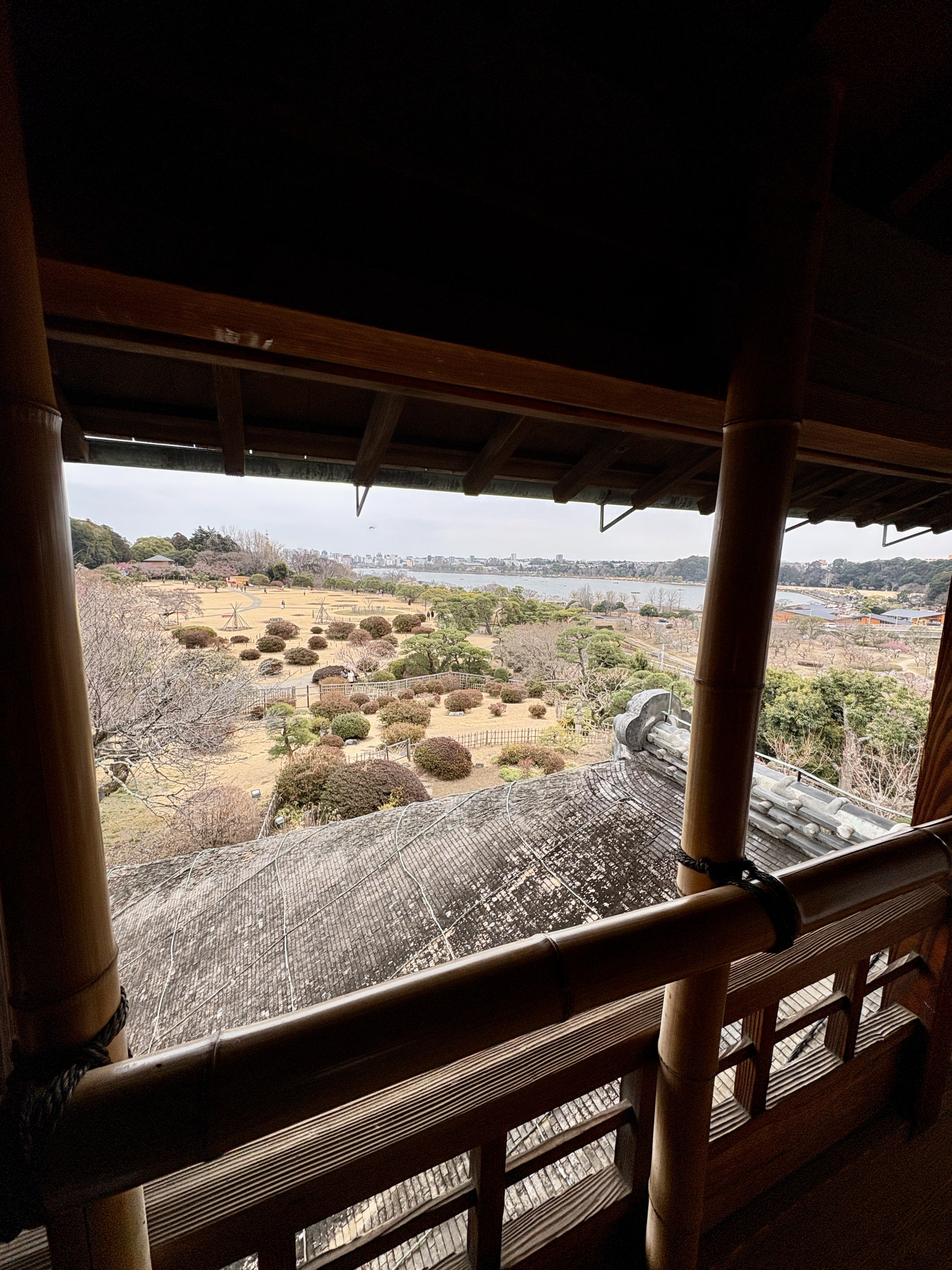
Seen through sliding doors and wooden pillars, the blossoms become living paintings — carefully composed scenes that change with light, wind, and time of day.
This framing is not accidental.
Traditional Japanese architecture was designed to harmonize with nature, allowing interior spaces to extend visually into gardens, creating continuity between built structure and landscape.
At Kobuntei, that design philosophy becomes tangible.
You are no longer just strolling through a garden.
You are observing it from the perspective of an Edo-period lord.
Architectural Highlights You Should Notice

Kobuntei consists of multiple rooms and levels, each offering a slightly different relationship with the surrounding plum grove.
The lower rooms, covered in tatami, were used for gatherings, poetry readings, and moments of rest, and their openness allows natural light to gently spill across the floors during daytime visits.
As you move upward, the vantage point expands.
From the upper floors, the view stretches across waves of blooming plum trees, revealing subtle variations in color — deep crimson, soft blush, and pure white — that blend into a textured early-spring landscape.
In February, when the air remains crisp and visibility is often clear, this elevated view feels especially serene.
Take your time here.
Sit quietly if allowed.
Notice how the building frames the horizon differently from ground level, creating a layered composition of garden, sky, and distant landscape.
If you enjoy photography, Kobuntei offers some of the most compelling angles in Kairakuen:
- Plum branches intersecting wooden beams
- Light filtering through shoji screens
- Tatami textures contrasting with blossoms beyond
The interior acts as a lens.
Why February Is the Ideal Time to Visit Kobuntei

February, known as Kisaragi in the traditional Japanese calendar, represents transition — a month that still carries winter’s chill while quietly preparing for spring’s arrival.
Plum blossoms bloom before cherry blossoms, symbolizing perseverance and resilience, as they open their petals despite the lingering cold.
This seasonal context deepens the experience of Kobuntei.
Inside the villa, you are surrounded by a philosophy that links intellectual growth with natural renewal; outside, you witness that renewal unfolding in real time through the plum blossoms.
The connection feels almost poetic.
And because February is less crowded than peak cherry blossom season, you have the rare opportunity to absorb the space without rush or distraction.
You can read the informational displays carefully.
You can stand silently at a window without feeling hurried.
You can imagine the conversations that once took place here — discussions about governance, literature, and cultural identity — while blossoms swayed just beyond the sliding doors.
That stillness is part of the experience.
Practical Tips for Visiting Kobuntei

If you are planning your visit, consider entering Kobuntei after spending time in the plum grove, so the transition from outdoor openness to indoor contemplation feels intentional and meaningful.
Morning to early afternoon offers the most balanced light inside the rooms, as natural daylight enhances both the wood tones and the view of blossoms without creating harsh shadows.
The entrance fee is modest, but the value lies in context.
Without Kobuntei, Kairakuen is undeniably beautiful.
With Kobuntei, the garden’s symbolism becomes clear.
Plan at least 30 to 45 minutes to explore slowly, especially if you wish to appreciate the upper-level views and architectural details.
Move quietly.
Observe carefully.
Allow yourself to experience the rhythm of the space.
What Kobuntei Teaches Modern Travelers

In contemporary travel culture, we often move quickly from one photo opportunity to another, collecting images rather than understanding the meaning behind them.
Kobuntei invites a different approach.
It reminds us that beauty was once tied to effort — that plum blossoms were admired not only for their appearance, but for what they represented: perseverance, scholarship, and the discipline required to flourish in difficult conditions.
The story that “plum blossoms bloom where learning thrives” may sound poetic, but it reflects a worldview in which nature mirrors human character.
Standing inside Kobuntei in February, watching blossoms bloom against the lingering cold, that philosophy no longer feels abstract.
It feels visible.
Final Reflection

Kairakuen is often described as one of Japan’s Three Great Gardens, and its plum blossoms are undeniably stunning in February.
But Kobuntei is what gives those blossoms narrative weight.
It is the place where a domain lord rested, read, and reflected.
It is the space where architecture frames nature deliberately, transforming landscape into lesson.
It is where the idea that learning cultivates beauty becomes more than metaphor.
If you visit Kairakuen during Kisaragi, do not let Kobuntei remain an optional extra.
Pay the 230 yen.
Step inside.
Stand at a wooden threshold and look outward toward blooming plum trees that symbolize both seasonal change and intellectual growth.
In that quiet moment, you may find that Kobuntei offers something rare in travel — not just scenery, but understanding.
And sometimes, understanding is what makes beauty unforgettable. 🌸
Leave a Reply