
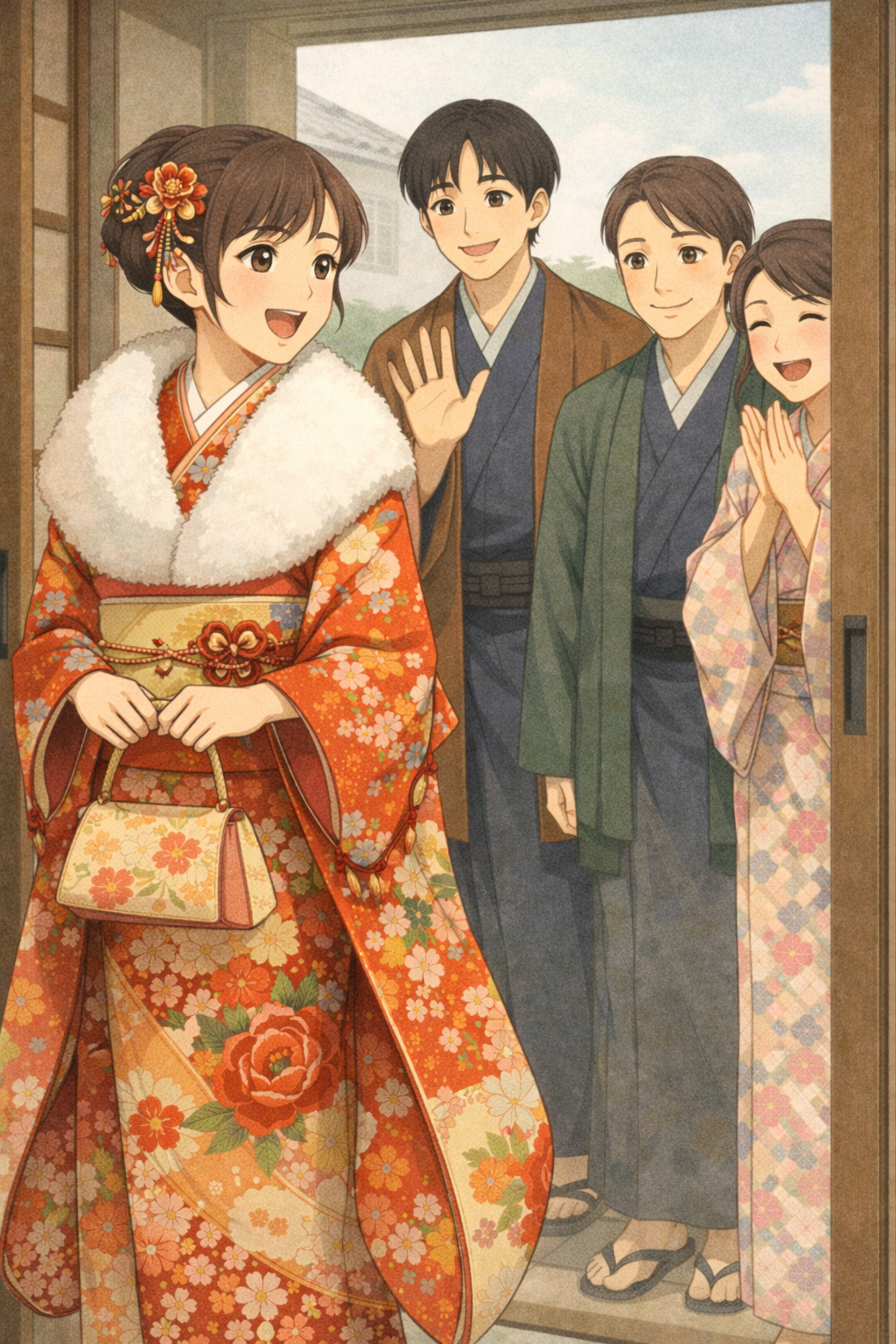
Every January, across Japan, young people dressed in elegant kimonos and sharp suits gather to celebrate a major milestone in their lives. This event is called Seijin Shiki, Japan’s Coming of Age Ceremony.
At first glance, it may look like a beautiful cultural festival—but behind it lies more than a thousand years of history, family bonds, and evolving ideas of adulthood.
In this article, I’ll guide you through what Seijin Shiki really means, where it comes from, how it’s celebrated today, and why it continues to matter in modern Japan—from quiet family moments at home to famously flashy ceremonies in places like Kitakyushu.
Contents
- What Is Seijin Shiki?
- A Ceremony With Ancient Roots: From Nara Period Rituals
- A Look Back: Seijin Shiki in the Showa Era
- Preparing for the Big Day: A Family Event
- The Ceremony Today: Reunions and New Beginnings
- The Famous Exception: Kitakyushu’s Flashy Seijin Shiki
- Why Seijin Shiki Still Matters
- Experiencing Seijin Shiki as a Visitor
- Final Thoughts: More Than a Ceremony
- Recent Posts
- Kagoshima: Exploring The Serene Onsen Of Kirishima
- Essential Japanese Phrases for Izakaya: Speak Like a Local in Japan
- A Vegan-Friendly Ramen Experience at Tokyo Ramen Street: Soranoiro
- A Hidden Ramen Gem in Waseda: My Visit to Shizuku
- What Is Yayoi? The Traditional Japanese Word for March Explained
- Share this:
- Like this:
What Is Seijin Shiki?

Seijin Shiki (成人式) is a Japanese ceremony held to celebrate young people who have reached adulthood.
In Japan, the legal age of adulthood was traditionally 20, and although it was lowered to 18 in 2022, Seijin Shiki is still mainly held for those turning 20.
The ceremony usually takes place on the second Monday of January, a national holiday known as Seijin no Hi (Coming of Age Day).
On this day, local governments invite eligible young adults to a formal ceremony at a civic hall. There are speeches from city officials, messages of encouragement, and sometimes small performances. But the ceremony itself is only part of the story.
A Ceremony With Ancient Roots: From Nara Period Rituals

Although Seijin Shiki feels modern, its origins date back over 1,200 years.
Genpuku and Mogi: Ancient Coming-of-Age Rituals
During the Nara period (8th century), coming of age was marked by ceremonial rites rather than birthdays.
- Genpuku (元服) was the coming-of-age ceremony for boys. They received adult hairstyles, clothing, and sometimes a new name.
- Mogi or Moegi (裳着) was the equivalent ceremony for girls, symbolizing their transition into womanhood through ceremonial dress.
These rituals were especially important among the aristocracy and are often depicted in classical literature such as The Tale of Genji. Becoming an adult meant stepping into social responsibility, not just personal freedom.
Modern Seijin Shiki is deeply influenced by these early traditions—even if today’s ceremonies look very different.
A Look Back: Seijin Shiki in the Showa Era

Seijin Shiki hasn’t always looked the way it does today.
During the Showa era (1926–1989), ceremonies were far more modest. Men typically wore dark suits, and women often chose simpler kimonos. In 1946, this ceremony was begun in Warabi city, Saitama prefecture. After WW2, in order to build up stronger Japan, younger generation becoming 20 years old were gathering and celebrate each other.
The mood was serious, hopeful, and restrained—reflecting a society focused on rebuilding and stability.
Photographs from this era show young adults standing proudly, not flashy or expressive, but determined. Becoming an adult meant contributing to society and supporting one’s family.
This contrast helps explain why modern Seijin Shiki has become more expressive—it reflects a changing Japan.
Preparing for the Big Day: A Family Event

For many Japanese families, Seijin Shiki begins at home, early in the morning.
Young women often wear furisode, a long-sleeved kimono reserved for unmarried women. The preparation process is detailed and time-consuming, involving professional hairstyling and kimono dressing. In some families, however, mothers help their daughters dress, turning the morning into an intimate, emotional moment.
Parents watch quietly as their child prepares to leave—proud, nostalgic, and sometimes a little teary-eyed. Older siblings often play the role of observers, witnessing the moment when their younger brother or sister steps into adulthood.
These quiet family scenes are rarely shown to tourists, but they are at the emotional heart of Seijin Shiki.
The Ceremony Today: Reunions and New Beginnings

At the ceremony venue, the atmosphere changes completely.
Young adults reunite with former classmates, often meeting friends they haven’t seen since middle school. There is laughter, surprise, and a shared sense of growth—“You’ve changed so much!” is heard everywhere.
For many participants, this is the first time they truly feel like adults. Not because of legal status, but because they stand together, reflecting on the past and looking toward the future.
While the ceremony itself may be formal and short, the social aspect—photos, conversations, and reunions—is what most people remember.
The Famous Exception: Kitakyushu’s Flashy Seijin Shiki

That’s so fashionable that, their kimono were held at the Paris Collection.
When people outside Japan hear about Seijin Shiki, one image often goes viral:
young men in outrageously flashy outfits, metallic kimonos, sunglasses, bold hairstyles, and confident poses.
This phenomenon is most famously associated with Kitakyushu, a city in southern Japan.
While some criticize these celebrations as disrespectful, locals often see them differently. For many participants, it’s a form of self-expression, pride, and even hometown identity.
Importantly, the participants still attend the ceremony. The flashiness happens before and after—during photos, gatherings, and celebrations with friends.
Kitakyushu’s Seijin Shiki reminds us that adulthood doesn’t look the same for everyone.
Why Seijin Shiki Still Matters
In a society where many traditional rituals are fading, Seijin Shiki remains surprisingly strong.
Why?
Because it connects:
- Past and present (ancient rites to modern celebrations)
- Family and society
- Individual identity and community belonging
It’s one of the few moments when an entire generation pauses together to reflect on responsibility, freedom, and the future.
For travelers and culture lovers, Seijin Shiki offers a rare window into Japanese values—not just what Japan looks like, but how it feels to grow up here.
Experiencing Seijin Shiki as a Visitor
If you’re visiting Japan in January, you may see groups of beautifully dressed young adults near train stations, shrines, or civic halls.
While the ceremonies themselves are usually closed to participants only, you can still respectfully observe:
- Furiosode kimonos in public spaces
- Family photo sessions
- Post-ceremony gatherings
Remember to be respectful—this is a meaningful day, not a performance.
Final Thoughts: More Than a Ceremony

Seijin Shiki is not just a single event.
It’s a story—one that stretches from ancient court rituals to modern city halls, from quiet family mornings to loud celebrations with friends.
Whether solemn or flashy, traditional or rebellious, every Seijin Shiki shares one truth:
Becoming an adult in Japan is not a moment—it’s a journey.


Leave a Reply