
Contents
- Introduction: Why Fugu Feels Intimidating but Irresistible
- What Exactly Is Fugu? (And Why You’ve Never Tried It Before)
- Why Yamaguchi Is Famous for Fugu — and Why That Matters
- The Reality of Traveling to Yamaguchi vs Staying in Kanto
- How Fresh Fugu Reaches Tokyo: Quality Isn’t Only About Location
- What Is Torafugu-tei?
- Safety First: Why Beginners Can Relax at Torafugu-tei
- What You Eat at Torafugu-tei: A Beginner-Friendly Breakdown
- How Much Does It Cost? Is It Worth It?
- How to Fit Fugu Into Your Tokyo Trip
- Final Thoughts: You Don’t Need to Go to Yamaguchi to Experience Fugu
- Recent Posts
- Kagoshima: Exploring The Serene Onsen Of Kirishima
- Essential Japanese Phrases for Izakaya: Speak Like a Local in Japan
- A Vegan-Friendly Ramen Experience at Tokyo Ramen Street: Soranoiro
- A Hidden Ramen Gem in Waseda: My Visit to Shizuku
- What Is Yayoi? The Traditional Japanese Word for March Explained
- Share this:
- Like this:
Introduction: Why Fugu Feels Intimidating but Irresistible
Fugu is one of those Japanese foods that most travelers recognize immediately, yet rarely feel confident enough to actually try during their trip.
You may have heard stories about danger, high prices, or strict rules, which naturally create hesitation before curiosity has a chance to grow.
At the same time, fugu carries a unique appeal.
It is famous not only because of its taste, but because it represents a food culture that exists almost exclusively within Japan’s tightly controlled culinary system.
Many travelers feel torn.
They are interested, yet unsure whether fugu is worth the time, money, or mental stress during a limited stay in Japan.
Some believe fugu is only for experts or locals who already understand the rules.
Others assume it belongs to once-in-a-lifetime luxury meals far outside a normal travel budget.
And yet, fugu remains one of the clearest examples of “a Japanese experience you cannot easily replace elsewhere.”
That thought often leads to a simple question: if not in Japan, where else could you try it?
This article is written for travelers who feel exactly that tension.
You do not need prior knowledge or confidence.
By the end, you will understand what fugu really is, why Torafugu-tei works so well for beginners, and how to decide calmly whether it fits into your Tokyo trip.
What Exactly Is Fugu? (And Why You’ve Never Tried It Before)

Fugu is a type of pufferfish that has long been part of Japanese food culture, while remaining almost completely absent from everyday dining outside the country.
The reason is simple: some parts of the fish naturally contain a powerful toxin.
Because of this risk, many countries choose to ban fugu entirely or allow it only under extremely limited conditions.
As a result, most travelers have never even seen fugu listed on a menu before arriving in Japan.
Japan approaches the issue differently.
Rather than avoiding the ingredient, it built a strict legal and training system to control how fugu is handled.
Chefs must complete specialized training and pass official exams before they are allowed to prepare it.
Only licensed professionals can serve fugu, and the process is closely regulated from preparation to presentation.
This system changes the meaning of fugu completely.
Eating fugu in Japan is not about thrill-seeking or taking unnecessary risks, but about trusting a framework that has been refined over decades.
That is why fugu can feel dangerous in theory, yet calm and controlled in practice when eaten at the right place.
Why Yamaguchi Is Famous for Fugu — and Why That Matters
When researching fugu, Yamaguchi Prefecture almost always appears as the symbolic center of fugu culture in Japan.
Historically, the region developed a strong relationship with fugu fishing, preparation, and culinary traditions.
This reputation matters because it shows that fugu is not a novelty dish.
It has regional roots, history, and cultural weight that food-focused travelers often value deeply.
However, this same reputation can unintentionally raise the bar too high.
You may start to feel that unless you travel all the way to Yamaguchi, the experience will somehow be incomplete.
That feeling is understandable.
Food culture often emphasizes authenticity through place, and Yamaguchi represents the “ideal origin” of fugu in many guides.
Travel reality, however, does not always allow for ideal routes.
The Reality of Traveling to Yamaguchi vs Staying in Kanto
Most visitors come to Japan with limited time and a fixed route.
Tokyo and the surrounding Kanto area already offer more food experiences than most travelers can realistically fit into one trip.
Adding Yamaguchi requires additional days, transfers, and costs that may not align with your original plan.
For many travelers, fugu alone is not enough reason to restructure an entire itinerary.
Choosing not to go does not mean you lack interest or appreciation for food culture.
It simply means you are making practical decisions based on time and energy.
This is where perspective becomes important.
If fugu is meaningful because it represents a rare Japanese experience, then accessibility matters just as much as origin.
The key question becomes whether Tokyo can offer a version of that experience that is safe, satisfying, and realistic.
How Fresh Fugu Reaches Tokyo: Quality Isn’t Only About Location
It is easy to assume that seafood quality depends entirely on how close you are to the ocean.
While location matters, modern Japanese food logistics rely far more on handling, timing, and professional control.
Seafood, including fugu, is transported under strict temperature management.
Speed and consistency play a critical role in preserving quality.
More importantly, preparation defines the final experience.
Who handles the fish, how it is processed, and whether safety protocols are followed matter more than distance alone.
This is why Tokyo, despite being far from Yamaguchi, can still offer high-quality fugu.
It does not replace the regional identity of Yamaguchi, but it provides a reliable alternative that fits urban travel.
For travelers, this distinction is crucial.
What Is Torafugu-tei?

Torafugu-tei is a restaurant chain that specializes exclusively in fugu, which already sets it apart from general seafood or izakaya-style restaurants.
Its entire operation is designed around handling one ingredient properly rather than offering variety.
For beginners, this focus is reassuring.
You are not walking into a place where fugu is an occasional menu item.
Some travelers hesitate when they hear the word “chain.”
They may associate chains with lower quality or generic experiences.
With fugu, however, consistency is a strength.
Standardized procedures reduce uncertainty, especially for first-time diners who want clarity rather than experimentation.
Another major advantage is location.
Torafugu-tei has multiple branches across the Kanto area, making it easy to integrate into a Tokyo-based itinerary without special planning.
If you wanna make a reservation, click this HOT PRPPER and search Torahugu-tei!
Safety First: Why Beginners Can Relax at Torafugu-tei

Safety is usually the first concern for anyone considering fugu for the first time, and that concern is completely reasonable.
Torafugu-tei addresses this not through marketing language, but through structure.
All preparation is handled by licensed professionals following fixed rules.
There is no improvisation and no ambiguity in how the fish is treated.
Menus are also designed with beginners in mind.
Rather than overwhelming you with choices, they guide you toward set courses that remove decision stress.
The atmosphere supports this approach.
Staff are accustomed to first-time customers, and asking questions feels natural rather than uncomfortable.
For travelers, this environment makes a real difference.
What You Eat at Torafugu-tei: A Beginner-Friendly Breakdown
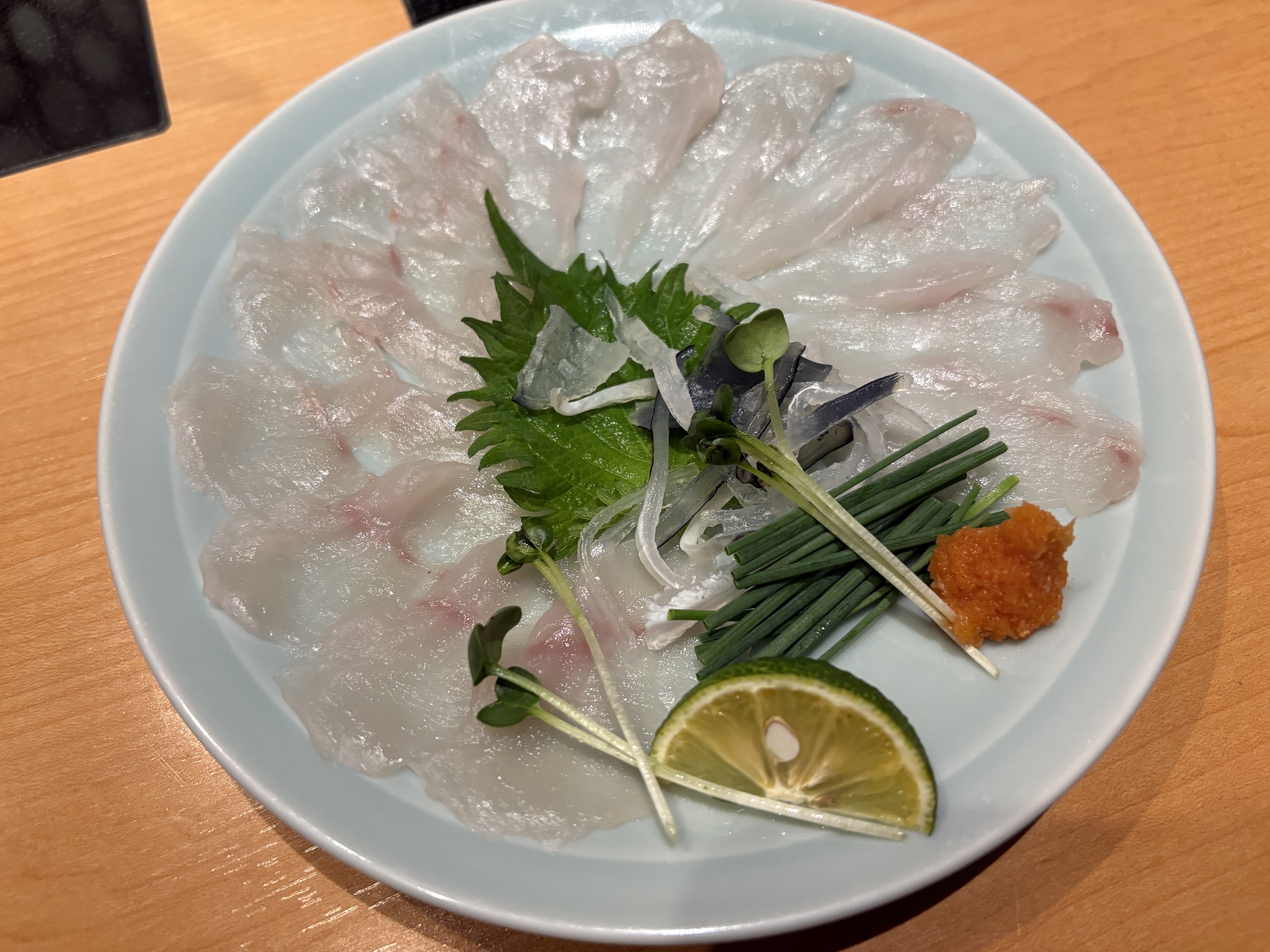
Tessa (Fugu Sashimi)


Tessa refers to thinly sliced raw fugu, arranged carefully on a large plate in a visually striking pattern.
The slices are almost transparent, which often surprises first-time diners.
In terms of flavor, tessa is mild and clean.
It does not have the strong taste many people associate with raw fish.
For those familiar with sashimi, it feels refined and delicate.
For beginners, it is often easier to enjoy than expected.
Tecchiri (Fugu Hot Pot)

Tecchiri is a hot pot dish where fugu is cooked gently in a light broth.
This style emphasizes warmth and comfort rather than intensity.
The flavor remains subtle, allowing the natural texture of the fish to stand out.
Many beginners find this dish particularly approachable.
Because the fish is cooked at the table, it often provides emotional reassurance as well.
Nervousness tends to fade once the meal begins.
Other Common Dishes
Many courses include additional dishes such as fried fugu or a rice dish at the end.
These elements add balance and make the meal feel complete.
For first-time diners, choosing a course is usually the best option.
It allows you to experience fugu in multiple forms without having to plan each step yourself.


So, flavored sake! And when you’re in Fugu restaurant, must try this sake!
How Much Does It Cost? Is It Worth It?
Fugu is not an everyday meal, and it is important to acknowledge that honestly.
At the same time, it is more accessible than many travelers initially expect.
At Torafugu-tei, prices are clearly structured around courses.
This transparency helps you decide whether it fits your travel budget without pressure.
Rather than asking whether fugu is cheap, it may be more useful to ask whether it offers something unique.
For many travelers, the answer lies in the fact that this experience is difficult to recreate outside Japan.
You are paying not only for food, but for skill, regulation, and cultural tradition.
Viewed this way, the cost often feels more reasonable.
How to Fit Fugu Into Your Tokyo Trip
Fugu works best as a planned dinner rather than a spontaneous stop.
It benefits from a relaxed pace and enough time to enjoy each dish.
There is no need for formal clothing.
Clean, casual attire is perfectly acceptable and common.
Making a reservation is recommended, especially during busy travel seasons.
It removes uncertainty and allows you to focus on the experience itself.
Think of fugu as one intentional evening rather than a comparison point for other meals.
It stands apart by nature.
Final Thoughts: You Don’t Need to Go to Yamaguchi to Experience Fugu

Yamaguchi will always hold a central place in fugu culture, and that history deserves respect.
Acknowledging that does not mean travelers must follow the same path.
Travel is a balance between ideals and reality.
Tokyo offers a practical way to experience fugu within a limited schedule.
Torafugu-tei provides structure, safety, and accessibility.
For beginners, that combination matters more than chasing perfection.
A meaningful experience does not need to be complicated.


Leave a Reply