
Tokyo is a city that feeds you relentlessly. Ramen at midnight, sushi at noon, yakitori after work, izakaya until the trains stop running. It’s magnificent — and eventually, your body starts quietly asking for a break. ALCHEMY is where you go when that moment arrives.
There’s a particular kind of craving that shows up mid-trip in Japan. You’ve had the omakase. You’ve done the standing sushi counter. You’ve eaten your way through Tsukiji and Yanaka and probably more tonkotsu than you planned. Everything has been incredible. And then, somewhere around day four or five, something in you just wants a plate full of vegetables.
Not a side salad. Not the pickled garnish that comes with your teishoku. A meal made of plants — vibrant, generous, and intentional about it.
That’s ALCHEMY’s exact moment. And they’re very good at what they do.
Contents
From Bali to Azabudai

ALCHEMY began in Bali, Indonesia, where it became a gathering point for health-conscious travelers from around the world — a place that eventually earned a spot among the “World’s Best Raw Food Restaurants.” The Tokyo outpost, which opened in November 2023, is the first overseas location of the Bali original, and it landed in arguably the most fitting address possible: the 4th floor of Azabudai Hills Tower Plaza, in a tranquil, design-forward setting that blends Bali-inspired furnishings with modern minimalism.
Azabudai Hills itself is worth understanding as a destination. The development — one of the largest urban redevelopment projects in Tokyo’s history — sits in Minato-ku, just a short distance from Roppongi, and houses TeamLab Borderless, a cluster of galleries, high-end residences, and an entire floor dedicated to food and wellness. It’s a place that was built to attract a globally minded, design-conscious crowd. ALCHEMY fits right in.
The interior features a wood-based design with ornamental plants and stone-like flooring that evokes natural warmth. Large windows allow sunlight to pour in, creating a space that feels like an oasis in the city. Furniture imported from Bali gives it a calm, tropical atmosphere. When you step off the escalator and walk in, the shift is immediate — the noise and scale of the complex outside dissolves, and you’re suddenly somewhere quieter and slower.
The space has 46 indoor seats and 28 terrace seats. On a clear day, the terrace is the place to be: surrounded by the geometric architecture of the towers, with glimpses of Tokyo Tower in the distance.
The Philosophy on the Plate

ALCHEMY’s commitment to plant-based eating isn’t a marketing position — it’s structural. All dishes are made from scratch using plant-based whole foods. No meat, fish, eggs, dairy products, or refined sugar are used. Everything is gluten-free and free from umami seasonings and chemical additives.
For travelers with dietary restrictions, this is genuinely significant. Japan is one of the world’s great food destinations, but navigating it as a vegan, vegetarian, or halal-observant traveler can require real effort. Plant-based options exist in Tokyo — they’re just not always easy to find or clearly labeled. ALCHEMY removes that friction entirely. The restaurant offers a vegan menu, a vegetarian menu, a gluten-free menu, and an oriental-vegetarian menu, with English-speaking staff and an English menu available.
The halal question is worth addressing directly: while ALCHEMY is not formally halal-certified, the complete absence of meat, alcohol-based ingredients, and animal products from the kitchen means that Muslim travelers who follow plant-based halal guidelines will find the menu largely compatible. It’s one of the more comfortable spaces in Tokyo for travelers with these needs — and that’s not something you’ll find clearly explained on most Tokyo food guides.
What to Order

The menu at ALCHEMY is wide enough that choosing can feel slightly overwhelming. Here’s how to approach it.
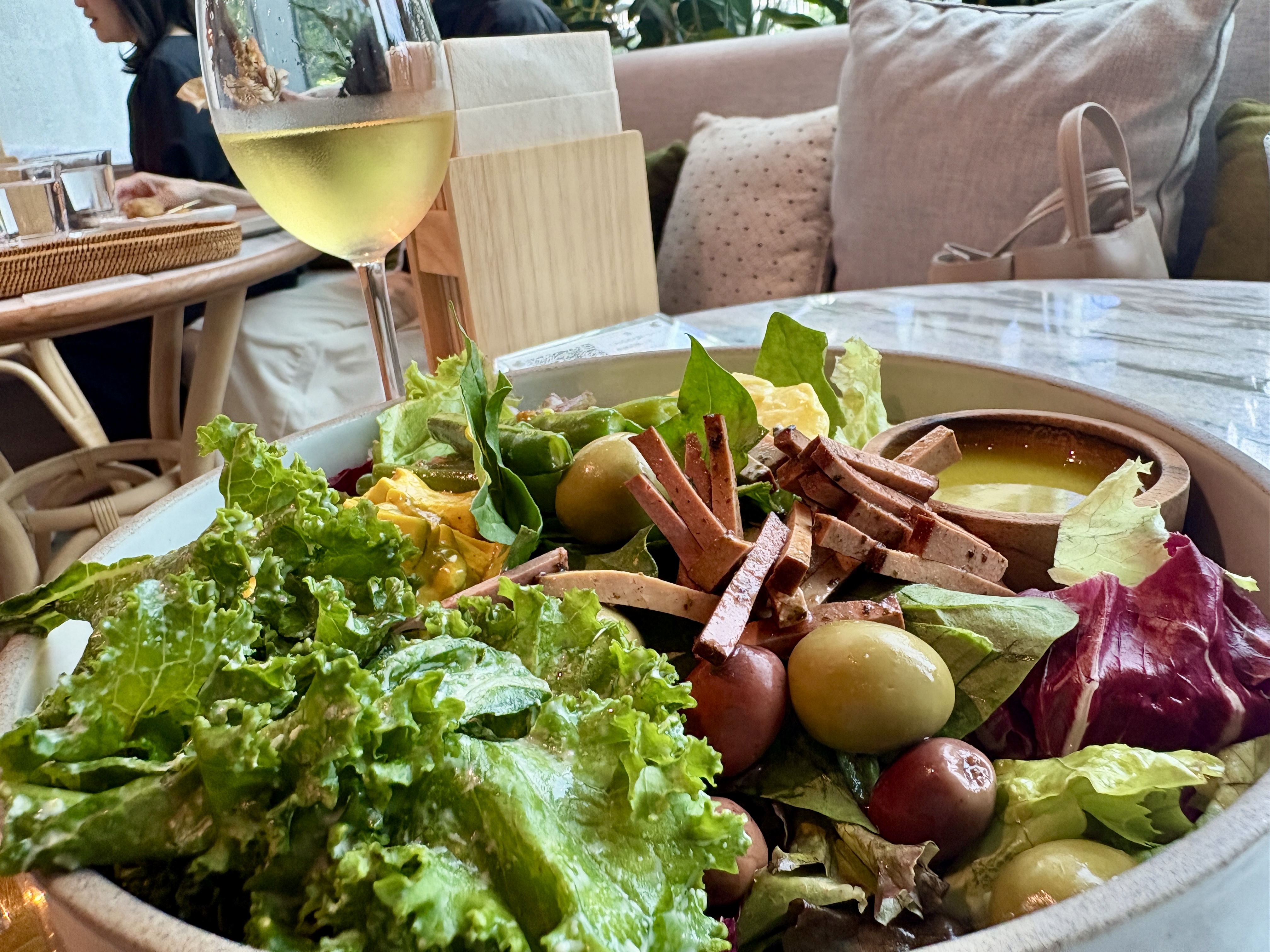
Start with the Salad Bar. This is the heart of the experience, and the thing Tossy came back for. The salad bar offers over 30 different toppings to choose from. You can see the ingredients and toppings displayed at the counter and enjoy selecting your favorites. The key thing to understand: the portions here are not Tokyo-small. The bowls are genuinely large — the kind of large where you look at it, think you’ll finish it easily, and then find yourself comfortably full halfway through. Order the salad alone and you will not leave hungry. That’s a promise.
The Born in Bali Bowl is the signature dish and earns its status. It’s a wholesome combination of brown rice, jackfruit “chicken,” tempeh manis, roasted pumpkin, kale tahini, and sambal matah, finished with a creamy tahini lemon dressing. The jackfruit mimics pulled meat in texture while the sambal matah — a raw Balinese chili relish — brings a brightness and heat that anchors the whole bowl. It’s the dish that most clearly explains where ALCHEMY comes from.
On the drink side, ALCHEMY produces its own cold-pressed juices daily, and the organic wine list is a genuine highlight. For an additional ¥1,400, you can add free-flow organic wine to certain lunch or dinner courses — a detail that surprises most first-time visitors. Yes, you can pair your vegan salad bowl with natural wine on a Tuesday afternoon. Tokyo contains multitudes.
The Honest Visitor’s Take

After a few days of heavy eating in Tokyo — good heavy, the kind you plan for — walking into ALCHEMY feels like exhaling. Not because the food is light (some of it isn’t — the richness of the Born in Bali bowl is real), but because every bite here is considered. Nothing is gratuitous. The kitchen isn’t trying to make you forget you’re eating plants. It’s trying to show you that plants, handled well, don’t require that trick.
The salad bowl in particular is the kind of thing you find yourself recommending before you’ve even finished it. The size alone defies expectations — this isn’t a side plate dressed up as a meal. It’s a proper, filling, generous bowl that leaves you satisfied rather than virtuous. There’s a difference, and ALCHEMY understands it.
The wine was a genuine surprise. Organic and clean, the kind that sits easily in the afternoon without weight. It pairs with the food in a way that feels natural — no awkwardness between the plant-based kitchen and the glass in your hand.
If there’s one criticism, it’s that the location inside Azabudai Hills can take a few minutes to navigate for first-time visitors. The complex is large and the signage, while clear, requires a moment of orientation when you arrive. Take the main escalators up to the 4th floor and follow the natural food cluster — once you’re on the right level, ALCHEMY is easy to find.
A Note on Timing
ALCHEMY tends to have more seating than some of the other cafes in the Azabudai Hills complex, which can mean shorter waits during peak mealtimes. That said, weekend lunches fill up. If you’re combining a visit with TeamLab Borderless — which occupies the lower floors of the same building — ALCHEMY makes an ideal either before or after stop. Post-TeamLab, when your senses are full and you want something grounding and nourishing, the timing is almost perfect.
Visit Information
ALCHEMY (アルケミー)
- Address: 4F Azabudai Hills Tower Plaza, 1-3-1 Azabudai, Minato-ku, Tokyo
- Nearest Station: Kamiyacho Station (Tokyo Metro Hibiya Line) — 10 min walk / Exit 2; Roppongi Itchome Station (Tokyo Metro Namboku Line) — nearby
- Hours: Daily 11:00 AM – 8:00 PM (last order 7:30 PM)
- Budget: Around ¥3,000–¥4,000 per person at lunch
- Payment: Credit cards, IC cards (Suica etc.), PayPay and major QR payment apps accepted
- Dietary: Fully vegan, gluten-free, no refined sugar, no chemical additives. English menu and English-speaking staff available.
- Reservations: Available via Tabelog (recommended for weekend lunch and dinner)
- Instagram: @alchemy.japan
***More info about Vegan-friendly place***
Leave a Reply