
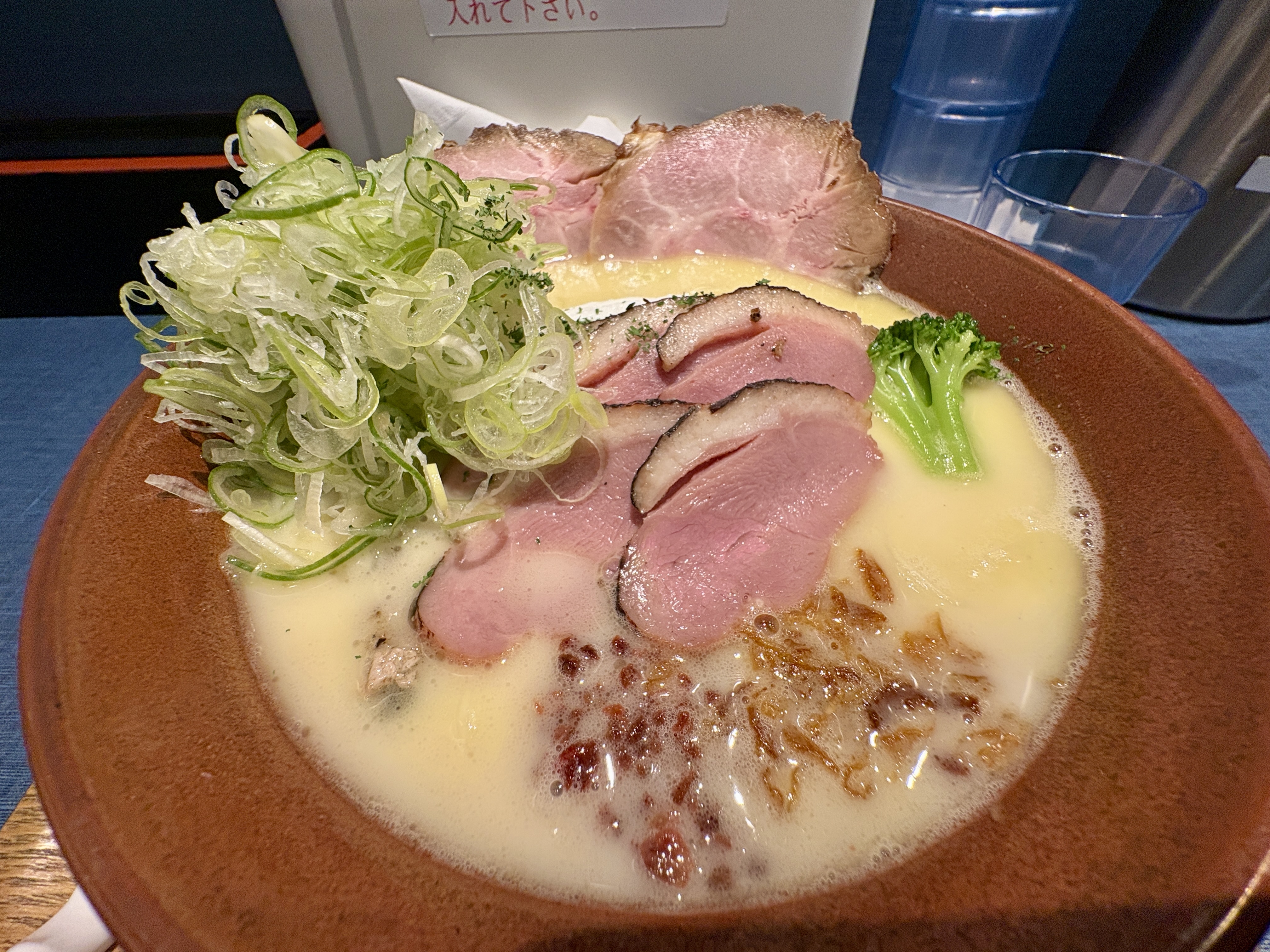
Tokyo’s ramen scene is vast — thousands of shops, endless variations, a bowl for every mood. But every once in a while, you stumble into a place that doesn’t fit any of the categories you thought you knew. Menko Ushio is that place.
Tucked into the basement of a quiet building just off Sotobori-dori in Kanda Awajicho, Ushio asks you to make a single choice before you do anything else: White or Black?
It sounds simple. It isn’t.

Contents
The Story Behind the Bowl
Before Ushio existed, owner Tsuchiya-san spent years in Sendai running a string of restaurants — an ethnic food bar, a garlic specialty shop, a sushi counter, an Italian izakaya. He wasn’t a ramen chef. He was something broader: a career cook who had touched almost every corner of Japanese and Western cuisine.
Then 2011 happened. The Great East Japan Earthquake shook his hometown of Miyagi and, as he later described it, shook something loose in him too. Surviving it made him ask a harder question: what do I actually want to make with the time I have?
The answer was ramen — but ramen like no one had made before. He moved to Tokyo, and in September 2012, Menko Ushio opened its doors in Kanda Awajicho. The philosophy was simple: take everything he’d learned from Italian technique, from Japanese tradition, from years of experimenting with flavors most ramen chefs had never touched — and build something that couldn’t exist anywhere else.
The result is a two-bowl menu that has been quietly drawing devoted regulars, curious travelers, and more than a few celebrities ever since.
The Two Choices
Shiro (White) — Tori Paitan Soba

The White bowl is the one that stops people mid-sentence.
The broth is built from the bones of Daisen chicken, a breed raised in Tottori Prefecture and prized for its clean, deep flavor. But what makes it unlike any paitan you’ve had before is what Tsuchiya-san does next: he folds in fresh cream, pulling the soup into something that sits closer to a French velouté or an Italian bisque than anything you’d call ramen broth.
The color is pure white — almost luminous. The texture is velvet. The flavor is rich without being heavy, savory with a gentle sweetness that only appears at the back of the palate.
The toppings continue the cross-cultural conversation: asparagus wrapped in meat, a poached egg sitting just soft enough that the yolk bleeds slowly into the broth, and a few carefully placed garnishes that wouldn’t look out of place on a fine dining plate. It doesn’t look like ramen. It doesn’t taste like ramen. And yet every element — the noodles, the balance, the warmth — is unmistakably a bowl of soba.
When I ordered the White, I genuinely paused after the first spoonful. There’s a moment in a good meal where your brain stops analyzing and just receives. This was that moment. The broth is so smooth, so layered, so quietly confident that you find yourself slowing down without meaning to — eating the way Ushio seems to want you to eat. Present. Unhurried. Paying attention.
Kuro (Black) — Nihonichi Shoyu Soba
The Black bowl takes a different road to the same level of craft.
Where the White leans into richness, the Black leans into purity. The broth is built almost entirely from plant-based ingredients: seven varieties of dried fish and kombu from Hokkaido, layered over time into a dashi that is deep, clear, and surprisingly complex. The only soy sauce Tsuchiya-san trusts for this bowl is Nihonichi Shoyu, produced by Oka Sanzaburo Shoten in Gunma Prefecture — a small-batch, premium product whose name literally means “number one in Japan.”
The result is not a bold bowl. It’s a considered one. The broth is darker, more austere, the kind of thing you sip slowly and keep returning to because each spoonful tastes slightly different depending on where the flavor is in its cycle.
The Black also happens to be, as a natural consequence of how it’s made, largely halal-compatible — something that has made it quietly popular with Muslim visitors from across Asia and beyond. Tsuchiya-san didn’t set out to make a halal bowl. He set out to make the best plant-forward broth he could. The compatibility was a byproduct of doing things the right way.
The Room
Ushio seats thirteen people — nine at the counter, four at a small table — in a basement space that feels more like a neighborhood lunch counter than a destination restaurant. The walls near the entrance to the noodle-making room are lined with photos of the owner posing with various celebrities, a detail that might feel incongruous elsewhere but here just adds to the lived-in feeling of the place.
The counter puts you close enough to watch the kitchen. The pace is calm. The staff moves without urgency, which is, in its quiet way, a signal: you’re not meant to eat fast here.
A Note for Travelers
Kanda Awajicho sits in the part of Tokyo that most itineraries skip entirely — not flashy, not photogenic, deeply local. That makes it exactly the kind of neighborhood ZEN Compass exists to point you toward.
From Awajicho Station (Tokyo Metro Marunouchi Line), Ushio is a one-minute walk. From Kanda Station on the JR lines, it’s about five minutes on foot. The shop opens at 11:00 AM and lunch queues form quickly, especially on weekdays when the surrounding office workers fill the seats early. If you’re visiting on a tight schedule, aim to arrive right at opening or after 1:30 PM when the first wave has cleared.
Ushio accepts credit cards, which is worth noting in a ramen landscape where cash-only signs still appear more often than you’d expect. The current price for either the White or Black bowl sits around ¥990 — exceptional value for the quality on offer.
On weekday evenings from around 6 PM onwards, a rotating selection of limited-run bowls sometimes appears. The summer cold version of the Black (Rei Kuro) has become something of a seasonal institution.
Who This Bowl Is For
If you’ve eaten ramen in Tokyo before and you’re looking for something that pushes the form rather than perfects the familiar, Ushio is a clear answer.
If you’re a first-time visitor and you want to understand how far Japanese culinary craft can stretch — how a dish associated with simplicity can carry the weight of a chef’s entire creative life — Ushio is an equally clear answer.
And if you’re traveling with someone who doesn’t eat meat, or keeps halal, the Black bowl gives you a way to share the table without compromise.
The choice between White and Black isn’t really about preference. It’s about which story you want to enter. Either way, you’re walking into a place where someone cared enough to build something entirely their own.
That’s rarer than it sounds, even in Tokyo.
Visit Information
Menko Ushio (麺巧 潮)
- Address: 2-4-4 Kanda Awajicho, Chiyoda-ku, Tokyo — Earl Kanda Awajicho B1F
- Nearest Station: Awajicho Station (Tokyo Metro Marunouchi Line) — 1 min walk / Ogawamachi Station (Toei Shinjuku Line) — 3 min walk / Kanda Station (JR) — 5 min walk
- Hours: 11:00 AM – 7:00 PM (check for current hours; irregular closures apply)
- Price range: Around ¥990 per bowl
- Payment: Credit cards accepted
- Phone: 03-6206-9322
- Seating: 13 seats (counter + small table)
Leave a Reply