
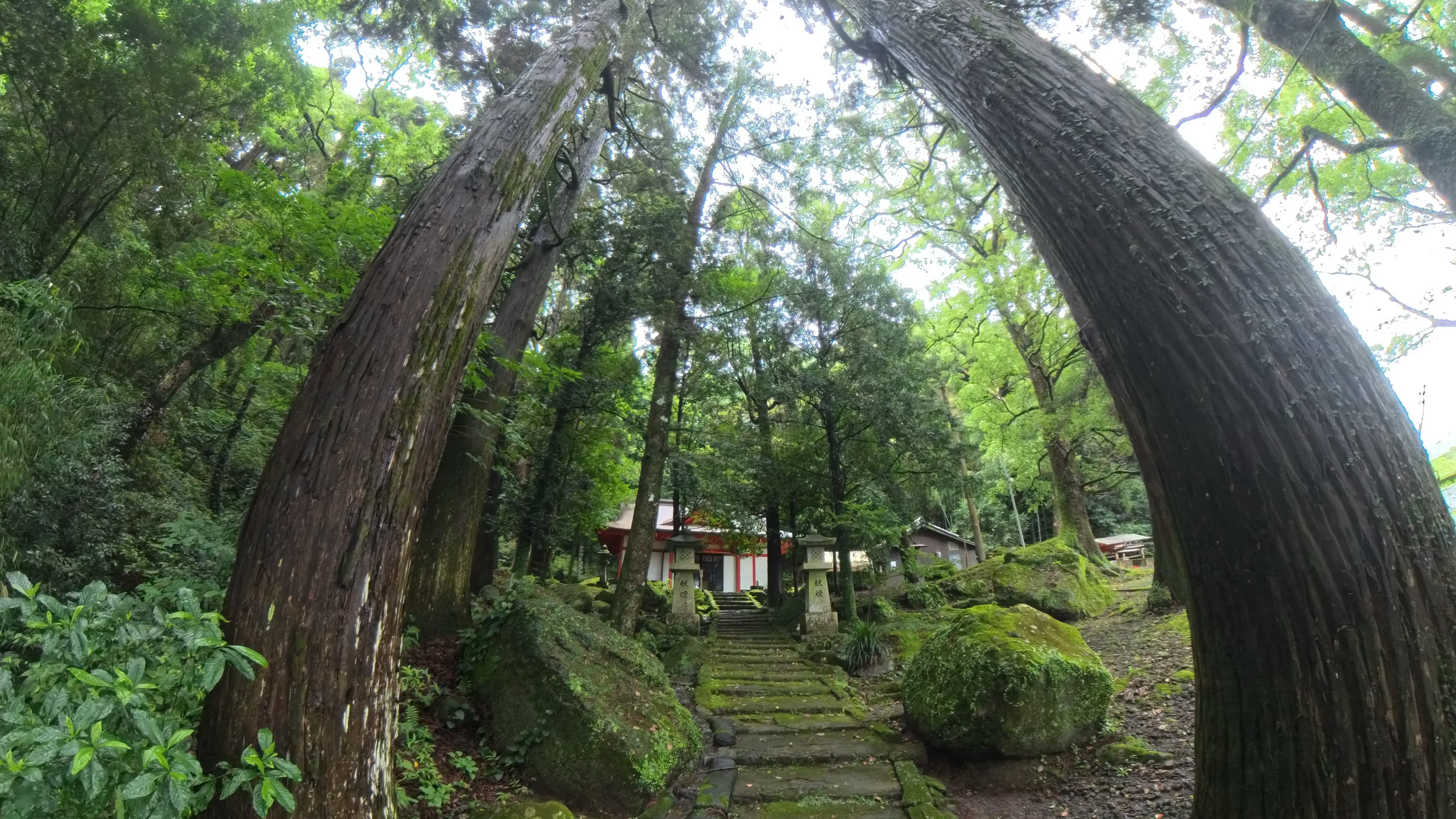
Hayato Town Kagoshima (隼人町, Hayato-chō), now part of Kirishima City, does not perform its history for visitors. It simply lives on top of it. Somewhere beneath these ordinary streets are the roots of a people written into Japan’s oldest chronicles, a grand shrine tied to the mythology of the imperial line, a modern shrine built by locals convinced their town once held the throne of Japan’s most enigmatic ruler, and a stone monument whose true purpose historians are still untangling. Ancient shrines Kirishima visitors seek out elsewhere in Japan sit here, largely undisturbed, within a twenty-minute walk of one another.
This is not a place that hands you its story. You have to slow down and ask for it — which, if you have come looking for the Japan that exists underneath the postcard, is exactly the invitation ZEN Compass exists to help you accept.
Who Were the Hayato? A People Written Into the Nation’s First Pages
To understand this town, you first need to understand the name it carries.

The Hayato (隼人) were a people of ancient southern Kyushu — the historical regions later organized as Satsuma and Osumi Provinces, roughly today’s Kagoshima Prefecture. They appear by name in Japan’s earliest chronicles, the Nihon Shoki (720 CE) and Kojiki (712 CE), and their culture is remembered for its martial skill, its distinct dances, and a mythological rivalry with the ancestors of the imperial line.
According to the Nihon Shoki, the Hayato formally submitted to the Yamato court in 682 CE, an event marked by a sumo wrestling match at the imperial palace between the Osumi Hayato and the Ata Hayato — a detail that is at once oddly specific and oddly human, a wrestling match standing in for the surrender of a people. After this, the Hayato were required to send tribute to the capital every six years, and select Hayato served the court in a striking ceremonial role: guarding the palace gates and imperial processions using a dog-like bark, a practice called haisei (吠声). It sounds strange to modern ears, but it reflected an old belief that the “barbarian voice” carried the power to ward off evil spirits. Hayato performers also taught and presented ritual dances — the Hayato-mai (隼人舞) — at court ceremonies, and produced bamboo hats and fans for the palace.
But submission was never total. The Hayato rebelled repeatedly against Yamato authority as the court pushed centralized land and tax systems onto a region that had long organized itself communally. Uprisings flared in 702 and 713, and in 720 CE a major rebellion broke out in Osumi Province after Hayato fighters killed the newly appointed provincial governor. The court dispatched a force of roughly ten thousand troops under the general Ōtomo no Tabito — the same Ōtomo no Tabito credited with a poetry gathering whose preface inspired the name of the Reiwa era, over a millennium later. The Hayato held out from several fortified strongholds for roughly a year and a half before the rebellion was suppressed in 721. After that, organized Hayato resistance ended, and — as one modern historical analysis notes — the term “Hayato” itself disappears from records referring to southern Kyushu’s population within about a century, meaning the people we call the Hayato were known by that name in the historical record for only around 120 years.
That is the story folded into the name of this ordinary-looking town: not a myth exactly, but a people who briefly, fiercely, held their own against a nation being built around them — and who were then folded into that nation’s memory, sometimes literally in stone, as you’ll see later in this piece.
Locals here will tell you they still carry that identity with pride. “Satsuma Hayato” remains a term of regional character to this day, evoked to describe a certain southern Kyushu spirit — direct, hardy, unpretentious. Standing on a quiet Hayato street, it’s worth remembering that the ground beneath you has carried that name, in one form or another, for well over a thousand years.
Kagoshima Jingu: The Great Shrine at the Town’s Heart

(A quick note for fellow travelers: you may see “Kagoshima Shrine” referenced online in connection with this area. The shrine you actually want — the historic Ichinomiya of Osumi Province, standing in Hayato itself — is Kagoshima Jingu (鹿児島神宮), not to be confused with the separate, smaller Kagoshima Shrine located in Kagoshima City. It’s an easy mix-up, and worth clearing up before you go.)
Kagoshima Jingu is the anchor of the entire town, and everything else in this guide sits in its orbit — literally within walking distance of its grounds.
Shrine tradition places its founding in 708 CE, though its own legends reach back further still, describing it as built on the former site of Takachiho-no-miya, the palace of the god Hikohohodemi-no-Mikoto — better known as Yamasachihiko, “Luck of the Mountains,” the central figure in one of Japan’s oldest myths. The shrine enshrines Yamasachihiko alongside his wife, the sea-princess Toyotama-hime, and — through a later merging with Hachiman worship — Emperor Chūai, Empress Jingū, and Emperor Ōjin. For centuries it was known as Ōsumi Shōhachiman-gū and ranked as the Ichinomiya, the highest-ranking shrine of Ōsumi Province, drawing deep reverence from the Shimazu clan who ruled the region.

The current main hall and worship hall date to 1756, rebuilt under the patronage of Shimazu Shigetoshi, and are now designated Important Cultural Properties of Japan. Walk the grounds slowly: vermillion structures rise beneath a canopy of old trees, and the atmosphere — even with other visitors present — tends toward hush rather than spectacle. A subsidiary shrine, Shakutai Jinja, is visited by those praying for safe childbirth, a living thread of devotion rather than a museum piece.
Each October, the shrine holds its Hayato Hamakudari (隼人浜下り) festival, a portable-shrine procession that travels from Kagoshima Jingu past the Hayato-zuka monument toward the sea — a ritual traditionally understood as, among other things, a way of consoling the spirits of the Hayato people. Whether or not you can time a visit to the festival itself, knowing that this procession exists, and where it walks, adds a quiet weight to a stroll along the same route on an ordinary afternoon.
Ebisu Shrine: A Small God’s Long Drift Ashore

Ebisu Shrine (蛭子神社 / 蛭児神社, Hiruko Jinja) sits a short walk northeast of Kagoshima Jingu, and if you visit only one smaller shrine in Hayato, this is the one to choose. It is, without exaggeration, one of the most quietly affecting sacred spaces in the region — the kind of place where you find yourself lowering your voice before anyone tells you to.
Historically, this shrine held real standing: through the Edo period it was ranked as Ninomiya, the “Second Shrine” of Ōsumi Province, second only to Kagoshima Jingu itself, and was known locally as Ninomiya Daimyōjin.
Its enshrined deity is Hiruko-no-Mikoto (蛭子尊), and his story is one of the more poignant threads in Japanese mythology. Hiruko was the first child born to the creator deities Izanagi and Izanami — but born incomplete, unable to stand even at three years old, and so, in grief, his parents set him adrift on the sea in a small boat. Local tradition holds that this boat — a heavenly vessel of camphor wood — eventually drifted ashore here, at what is now the shrine’s site, and that a branch from the vessel took root and grew into an enormous camphor tree. The current sacred camphor in the precinct was replanted in 1728 by a local magistrate, a literal continuation of that legend still growing on the grounds today. The shrine buildings themselves were rebuilt in 1750, and again more recently in 2011, though the site’s origins are traditionally traced back to the age of the gods.

Over centuries, Hiruko came to be identified with Ebisu, one of Japan’s Seven Lucky Gods — patron of fishermen, safe voyages, and honest commerce, usually depicted with a fishing rod and a red sea bream tucked under his arm. It is a gentle transformation: a rejected, drifting child becoming, in the end, a god of good fortune. There is something in that arc worth sitting with quietly, rather than photographing quickly and moving on.
The shrine’s annual festival falls on June 16th. Outside of festival days, expect near-total stillness — birdsong, the rustle of the old camphor, and very possibly no one else there at all.
Himiko Shrine: Where an Old Mystery Gets a New Address

A short walk from Kagoshima Jingu, tucked beside a small river crossed by a bridge that locals have named Himiko-bashi, stands a modest torii gate and an even more modest shrine building: Himiko Shrine (卑弥呼神社).
Here, a note of honesty matters more than anywhere else on this list. This is not an ancient shrine. Records and on-site plaques indicate it was established in 1982, and it does not appear in the official registry of the Kagoshima Prefectural Shrine Association — suggesting it was built privately, by local residents advocating for a particular theory about Japanese history, rather than through any documented ancient lineage.
The theory in question, though, is a genuinely fascinating one, and it’s worth understanding why someone here felt strongly enough to build a shrine around it. Himiko was the shaman-queen who ruled Yamatai-koku (邪馬台国), a confederation of communities described in the 3rd-century Chinese chronicle Records of the Three Kingdoms. Yamatai’s exact location is one of the longest-running mysteries in Japanese archaeology and history — a debate that has run for well over a century, with the two leading camps arguing for either the Kinki region (near modern Nara) or northern/central Kyushu. Some proponents extend the Kyushu theory further south, arguing that Himiko’s stronghold sat in the Kokubu-Hayato area — precisely here.

This shrine enshrines Himiko herself, along with Himikoko (卑弥弓呼), the king of the rival state of Kuna-koku, said to have been at war with Yamatai — a conflict in which, according to Chinese records, Himiko may ultimately have died. A statue of the queen stands beside the modest main hall.
Treat this shrine for what it is: not a physical relic of ancient Yamatai, but a tangible expression of how alive that debate still is in local memory — a piece of civic imagination built by people proud enough of a theory about their hometown’s deep past to give it an actual address. That, in its own way, is worth the short detour. Just don’t mistake devotion for archaeology.
Hayato-zuka: A Monument That Outgrew Its Own Legend

A short distance from the shrine cluster, in the Mitsugi area of town, rises a low mound just a few meters high, crowned with three stone pagodas and, standing guard around them, four weathered stone statues of the Four Heavenly Kings — Jikokuten, Zōjōten, Kōmokuten, and Tamonten, the traditional Buddhist guardians of the cardinal directions. This is Hayato-zuka (隼人塚), a nationally designated historic site, and easily the most quietly dramatic single image in the entire town.
For generations, local tradition held — and the monument’s very name reflects — that it was built in 720 CE to console the spirits of Hayato warriors killed in the great rebellion against the Yamato court described earlier in this article. It is an intuitive, moving story: a monument raised in the same year as the uprising, to honor the defeated.
But archaeology tells a more complicated tale. Excavations at the site revealed that Hayato-zuka was actually constructed considerably later, in the late Heian period (11th–12th century), as a Buddhist religious site — likely an early precursor to a nearby temple, Shōkoku-ji, historically associated with Kagoshima Jingu. In other words, the mound is not literally an 8th-century burial site for Hayato dead; it is a piece of medieval Buddhist architecture that, over the following centuries, absorbed and carried forward the memory of the Hayato Rebellion, whether or not it was built for that purpose.
There is something quietly moving in this correction rather than something disappointing. A monument doesn’t need to be literally what a legend claims for it to function as a place of remembrance. For roughly three hundred years, this hilltop has done the emotional work of honoring people defeated thirteen centuries ago — and Kagoshima Jingu’s autumn Hayato Hamakudari procession still passes this very spot on its way to the sea, a living ritual thread connecting shrine, mound, and memory in a way no archaeological revision can undo.
The adjacent Hayato-zuka Historic Site Museum (隼人塚史跡館) lays all of this out clearly — the Hayato people, the excavation findings, the restored monument, and the festival — and is worth ten quiet minutes before or after standing at the mound itself.
Planning Your Visit: Access, Pacing, and Timing
Getting to Hayato:
- From Kagoshima Airport: Roughly 15–20 minutes by taxi or car. By public bus, expect around 30–45 minutes, typically with one transfer near the airport or in central Kirishima; fares run in the ¥500–600 range. If your itinerary is airport-adjacent, Hayato makes a genuinely excellent first or last stop in Kagoshima.
- From Kagoshima City (Kagoshima-Chūō Station): Take a JR Nippō Main Line train to Hayato Station — a straightforward, scenic ride of roughly 35–45 minutes depending on the service. Confirm current timetables, as rural line schedules can be sparse outside peak hours.
- From Kirishima Onsen / Kirishima Jingu area: About 20–30 minutes by car. No direct rail connection exists between the two, so a car, taxi, or connecting bus is the practical choice.
Getting around once you’re there:
Hayato Station sits within comfortable walking distance of Kagoshima Jingu (roughly 15 minutes on foot), and the shrine itself functions as a natural hub: Ebisu Shrine, Himiko Shrine, and Hayato-zuka are all within a further 10–20 minute walk of the main shrine grounds and of each other. A rental bicycle — ask locally, as options are limited but do exist — turns the whole loop into an easy, unhurried hour or two rather than a half-day trek. A car gives the most flexibility but is not strictly necessary if you’re comfortable walking.
How much time to allow: A slow half-day (roughly 3–4 hours) lets you visit all four main sites without rushing, plus the small museum at Hayato-zuka. This is not a place designed to be conquered in an hour between bigger attractions — and trying to do so will cost you the exact quality that makes it worth visiting.
Best season: Spring (March–April) and autumn (October–November) offer the most comfortable walking weather and, in October, the possibility of encountering the Hayato Hamakudari procession itself. Summer in this part of Kagoshima is hot and humid; if you visit then, plan for a morning start.
Hayato’s greatest asset, across every season, is simply its quiet. Unlike Sakurajima’s ferry crowds or Kagoshima City’s tram-lined streets, you can stand at Ebisu Shrine on an ordinary Tuesday afternoon and hear nothing but wind in an eight-hundred-year-old camphor tree. That silence is not an absence of things to see — it’s the whole point.
Visiting Hayato with Respect
Hayato is a living residential town, home to real families and small daily businesses — not a heritage theme park maintained for visitors. A few principles carry that awareness into practice:
- Keep your voice low near the shrines. These remain active places of worship, not photo backdrops. A bow at the torii before entering, and quiet observation once inside, costs you nothing and means a great deal.
- Follow basic shrine etiquette: a small bow before passing through the torii, a coin offering and two bows–two claps–one bow at the main hall if you choose to pray, and photography of the shrine buildings taken with the same restraint you’d want shown toward your own place of worship.
- Support the small shops you pass — a drink from a local vending machine is fine, but a meal or a small purchase at a family-run shop does more for a town that sees relatively few international visitors.
- Leave no trace. There are few visitor facilities here precisely because visitor numbers remain low; carry out what you carry in.
- Hold the corrected history lightly, not smugly. Knowing that Himiko Shrine is modern, or that Hayato-zuka isn’t literally an 8th-century burial mound, is interesting — but it isn’t a reason to dismiss what these places mean to the people who built and still tend them. Curiosity with humility means holding facts and local devotion in the same open hand.
This, in the end, is what a town like Hayato asks of you: not a checklist, but presence. Come slowly, leave quietly, and let a genuinely ancient story — however tangled its threads have become — settle in as memory rather than souvenir.
FAQ: Hayato Town, Kagoshima
Is Hayato Town worth visiting?
Yes, especially if you’ve already seen Kagoshima’s more visited sites and want a quiet, walkable half-day rooted in genuine ancient and medieval history — a cluster of shrines and a national historic site within a compact, easily walkable area, with almost none of the crowds found elsewhere in the prefecture.
How far is Hayato from Kagoshima Airport?
About 15–20 minutes by car or taxi, or roughly 30–45 minutes by public bus, usually with one transfer. This makes it a convenient stop near the start or end of a Kagoshima itinerary.
What is the Hayato-zuka?
A nationally designated historic site featuring three stone pagodas guarded by four stone statues of Buddhist Heavenly Kings. Local legend ties it to the memory of the Hayato people defeated by the Yamato court in 720 CE, though archaeological research suggests the monument itself was actually built later, in the late Heian period, as a Buddhist religious site.
What is the connection between Hayato and Himiko, the legendary queen of Yamatai?
None that can be historically confirmed — but a modern shrine built in 1982 by local advocates of a theory placing Yamatai-koku in the Kokubu-Hayato area gives that old debate a physical, visitable presence in the town today.
***More info about Kagoshima***
Leave a Reply