
I Had Seen It for Years. I Had Never Been To It.
I’ve come to Kagoshima almost every year for longer than I can now count on one hand. I’ve eaten at the same counters, walked the same waterfront, watched the same plume of smoke rise from across Kinko Bay so many times that it became, in a strange way, wallpaper — a fixed, familiar shape on the horizon, the thing that told me I’d arrived.
I had never crossed the water to it.
This trip, finally, I did. And I want to be honest about what that confession says: for years, Sakurajima (桜島) was something I looked at, not something I understood. It took an actual fifteen-minute ferry ride — shorter than the walk from my hotel to the station — to turn a postcard into a place, and a mountain I’d merely admired into one I suddenly, physically respected. The smoke that had always looked soft and distant from the city became, up close, enormous: a column rising off a peak that was doing this, quietly, continuously, while an entire community went on living directly beneath it.
That’s the story this article is really about. Not sightseeing — arriving.
Living With a Volcano: Sakurajima’s Real Story

Here is the fact that reframes everything else: Sakurajima is the only place in Japan — and one of vanishingly few places on Earth — where a settled community lives in ongoing, daily relationship with an actively erupting volcano. Not a dormant one. Not a “once erupted, now a symbol” one. An active one, monitored around the clock, that has produced small eruptions and explosions with real regularity for decades.
The eruption that made this island a peninsula: On January 12, 1914 (Taishō 3), Sakurajima produced the largest volcanic disaster Japan experienced in the 20th century. Fissures opened on both the eastern and western flanks of the mountain, releasing an estimated two cubic kilometers of lava, ash, and pumice. The eastern lava flow crossed the roughly 400-meter strait separating the island from the Ōsumi Peninsula and filled it entirely — permanently connecting what had been an island to the mainland. A magnitude-7 earthquake struck the same day. Fifty-eight people died, many of them drowned while evacuating, and 120 homes were completely destroyed. Kagoshima Prefecture now observes January 12 as “Sakurajima Day,” running evacuation drills in its memory every year.
What “living with it” actually looks like today: After a quiet period, the Minamidake summit crater began erupting again in 1955 and has remained active in some form ever since, with activity shifting to the Shōwa crater from 2006 onward. For residents, this isn’t abstract. Ash-fall (kōka, 降灰) is a genuine part of daily infrastructure planning: homes have dedicated collection points for swept ash, cars are washed more often than almost anywhere else in Japan, laundry gets timed around wind direction, and schoolchildren have grown up practicing ash-appropriate routines the way children elsewhere practice earthquake or fire drills. None of this is performed for visitors. It is simply how a town organizes its Tuesday.

Right now, in 2026: As of this writing, Sakurajima is under Alert Level 3 (entry restriction) — a level that briefly escalated to the maximum, Level 5 (evacuation), in July 2026 following a summit explosion that sent large ballistic rocks beyond 2 kilometers from the crater, before being lowered back to Level 3 later that month. This is genuinely current, evolving information, and it’s exactly why the “practical guide” section below matters more than usual on this particular trip.
None of this is meant to alarm you out of visiting. It’s meant to correct the postcard version of Sakurajima into the real one: not a backdrop, but a home that several hundred thousand people share with a mountain that erupts, and that has quietly built an entire culture of coexistence around that fact.
Getting There: The Ferry That Isn’t a Tour Boat

The crossing itself is where the reframing starts. The Sakurajima Ferry (桜島フェリー) runs between Kagoshima Port and Sakurajima Port in about 15 minutes (occasionally 20, depending on sea conditions), and it is, first and foremost, a working commuter line — carrying cars, delivery trucks, school groups, and daily commuters alongside visitors, not a curated tourist experience. As of October 2025, the ferry moved from round-the-clock service to a schedule running from 4:00am to 11:30pm; departures run frequently throughout the day (roughly every 15–20 minutes at peak times), so you’ll rarely wait long. One-way fare for adults is in the ¥200–250 range (fares have adjusted recently, so confirm current pricing at the terminal), with cars and motorcycles able to board as well.
Stand at the rail for this one rather than sitting inside. Watching Sakurajima grow from a shape on the horizon into an actual, textured mountain — its ridgelines sharpening, its smoke column resolving into something you can watch move — is a genuinely different experience from viewing it as scenery from the city. Grab a bowl of the ferry’s small, famous onboard udon stand (locally known simply for being an unpretentious, quick, and oddly perfect bowl to eat mid-crossing) if you’re hungry; it’s as local an institution as the route itself.

The Loop Bus: A Compass, Not a Fixed Map

Once you’re on the island, the Sakurajima Island View loop bus (サクラジマアイランドビュー) is the easiest way to see it properly — but treat the route as an orientation, not an obligation. You’re free to get off wherever draws you and simply wait for the next bus to continue.
The loop departs from and returns to Sakurajima Port, running roughly every 30 minutes between about 9:30am and 4:30pm, with a full circuit taking 55–60 minutes if you stay aboard the whole way. A day pass (around ¥500 for adults, ¥250 for children) lets you hop on and off freely and includes small discounts elsewhere on the island.
Key stops along the route, in order:
- Sakurajima Port — where you’ll arrive and depart.
- Hi no Shima Megumi-kan (火の島めぐみ館) — the island’s roadside station, selling local produce and Sakurajima specialties.
- Rainbow Sakurajima — a national lodge with a public hot spring.
- Sakurajima Visitor Center — a genuinely worthwhile stop for understanding the volcano’s history and current monitoring before you go further.
- Karasujima Observation Point — a compact, dramatic viewpoint.
- Akamizu Observation Plaza — home to a monument commemorating a famous all-night concert once held here, and one of the island’s most photographed lava-field views.
- Sakurajima International Volcanic Disaster Prevention Center — panel displays on past eruptions and mudflow (dosekiryū) events.
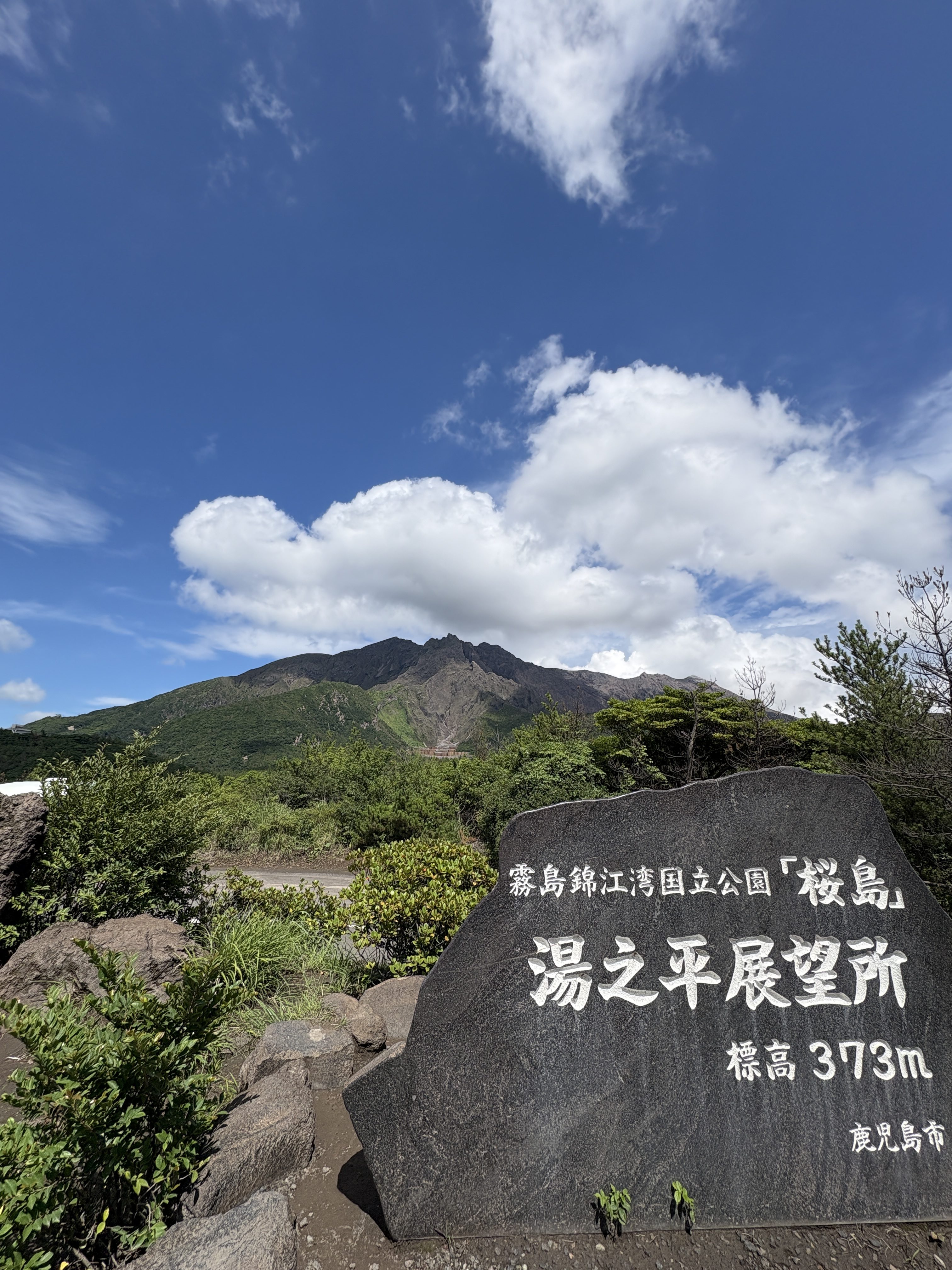
- Yunohira Observation Deck (湯之平展望所) — at 373 meters, the highest point the general public can reach, and the closest legal vantage to the active crater. The rugged flank of the northern peak fills your view here; look for seven small heart-shaped stones worked into the surrounding stone wall, a small local tradition of searching for luck.
A full loop with a few stops takes a comfortable half-day; add the Visitor Center and a longer pause at Yunohira, and it fills a full one easily. There’s no single “correct” way to do this — orient yourself with the map, then let curiosity choose the stops.
Tsukuyomi Shrine: Facing the Mountain That Made the Island

A short walk from the ferry terminal — close enough that it’s easy to overlook, tucked right beside where most visitors are already rushing toward the bus stop — stands Tsukuyomi Shrine (月読神社), the largest shrine on Sakurajima, and, for me, this trip’s genuine center of gravity.
A necessary correction to make honestly, since it matters for understanding the place: the shrine’s principal deity, as its name states plainly, is Tsukuyomi-no-Mikoto (月読命), the Shinto moon god — not the volcano goddess alone, as is sometimes assumed. Tsukuyomi Shrine is what’s called a gōshi shrine, formed from an older merger of several sacred sites, and carries the local nickname Goshadaimyōjin-sha (五社大明神社) — “the shrine of five great deities” — reflecting the five kami enshrined together here: Tsukuyomi-no-Mikoto, Ninigi-no-Mikoto, Hikohohodemi-no-Mikoto, Ugayafukiaezu-no-Mikoto, and, among them, Konohanasakuya-hime-no-Mikoto (木花咲耶姫命).
It’s Konohanasakuya-hime who carries the story most travelers come here for. In the Kojiki, Japan’s oldest chronicle, she is the wife of Ninigi-no-Mikoto — and when Ninigi doubted that the child she carried was truly his, she resolved to prove it in the most literal way imaginable: sealing herself into a doorless birthing hut and setting it ablaze from within, declaring that if the child was not divine, both would perish in the flames. She gave birth to three sons unharmed inside the fire. It’s this act — willingly entering flame to prove purity and safety — that made her, across Japan, the deity most closely associated with calming volcanic fire, most famously enshrined at Mount Fuji’s Sengen shrines.

Local tradition holds that Konohanasakuya-hime’s name may be the root of “Sakurajima” itself — sakuya echoing into sakura — though it’s worth saying plainly, as local sources do themselves, that this is one theory among several competing explanations for the island’s name, not a settled fact. What is documented is this: the shrine is believed to trace back to the Wadō era (708–715 CE), stood for centuries on higher ground before being moved to the shoreline in 1625, and — like so much else on this island — was buried under lava during the 1914 Taishō eruption. It wasn’t until 1940 that it was rebuilt at its current site.
Standing in front of it, facing back toward the smoking peak the shrine’s own goddess is said to calm, is the closest this island comes to making its central paradox visible in a single view: reverence and danger, occupying the same sightline. This isn’t costume-drama mythology performed for cameras. Every October 30th, the shrine holds its Toyo-sai (豊祭) festival — a real, ongoing community event featuring a large mikoshi (portable shrine) procession down to the beach, prayers for children’s health, and traditional Kagoshima performing arts including kagura dance and bō-odori stick dancing. People here don’t visit this goddess as folklore. They ask her, sincerely, for exactly what her story promises: safety from the fire they live beside every day.
Take a few minutes here before you rush to the bus stop. Few visitors do, which is precisely what makes the quiet so complete.
A Landscape the Volcano Built
Everything you’ll walk across on Sakurajima was, in some geological sense, recently made. The Taishō lava field near Akamizu is the most immediate evidence — a wide, black, textured expanse of solidified flow, still visibly raw compared to land shaped by centuries of erosion elsewhere in Japan. Elsewhere on the island, black volcanic sand replaces the pale beaches more common along this coast, and even the soil supporting Sakurajima’s famous namesake produce — the enormous Sakurajima daikon radish and some of Japan’s smallest, sweetest mandarin oranges — is mineral-rich, volcanic ground.
If your itinerary extends to the island’s eastern Kurokami district, you’ll find one of Sakurajima’s most striking physical witnesses to the 1914 eruption: a large stone torii gate, once standing roughly three meters tall, buried up to its crossbeam in ash and pumice during the Taishō eruption and deliberately left in place ever since — a monument to a different local shrine, preserved exactly as the ash left it, rather than dug out.
None of this reads as conventionally “photogenic” in the postcard sense. It reads as something closer to true: land still visibly becoming itself, one eruption at a time.
Planning Your Crossing
Ferry: Kagoshima Port to Sakurajima Port, about 15 minutes, running roughly 4:00am–11:30pm (revised from 24-hour service as of October 2025). Adult fare approximately ¥200–250 one-way; confirm current pricing at the terminal, as this has changed recently. No reservation needed for foot passengers.
Loop bus: Sakurajima Island View, departing Sakurajima Port roughly every 30 minutes, 9:30am–4:30pm, full loop 55–60 minutes. One-day pass approximately ¥500 (adult) / ¥250 (child), purchasable on board or at several city tourist information points.
Time to allow: A half-day covers the ferry, a partial loop, and Tsukuyomi Shrine comfortably. A full day allows the Visitor Center, a longer stop at Yunohira, and unhurried time at the shrine.
Current volcanic status (check before you go): As of this writing, Sakurajima is at Alert Level 3 (entry restriction), covering roughly the area within 2 kilometers of the active Minamidake and Shōwa summit craters — this affects mountaineering and trail access near the summit, not standard visitor routes like the ferry, loop bus stops, or Yunohira Observation Deck. However, the level briefly reached the maximum (Level 5, evacuation) in July 2026, which underlines that conditions here genuinely do change. Always check the Japan Meteorological Agency’s latest advisory (or ask at the Visitor Center) immediately before your visit, and follow all posted instructions without exception.
What to bring: A small bag or cover for cameras and phones if ash-fall is active that day, a scarf or light mask for the same reason, and clothes you don’t mind getting a little dusty. None of this is about danger to a standard visitor on a normal day — it’s simply Sakurajima’s actual weather.
Best viewpoints: Yunohira Observation Deck for the closest legal view of the crater; Akamizu Observation Plaza for the lava field; and, if time allows, the return ferry crossing at dusk, watching the mountain recede the way it once only ever approached you from the city side.
Visiting a Home, Not an Attraction
The single most important thing to carry onto that ferry with you is this: Sakurajima is where people live, not a stage set built for your visit.

- Follow every safety instruction without negotiation. If a trail, road, or area is marked restricted — especially given the current Level 3 advisory — that restriction exists for a documented, monitored reason, not as a suggestion.
- Don’t treat ash-sweeping, daily routines, or residents themselves as photo subjects without care. A shopkeeper clearing ash from a doorway is doing chores, not performing local color.
- Spend where it actually reaches the island. Hi no Shima Megumi-kan, the roadside station along the loop bus route, sells genuinely local produce and Sakurajima specialties — the small mandarins and the famously enormous daikon among them — and is a straightforward, real way to put money into island livelihoods rather than mainland souvenir chains. The ferry’s own onboard udon counter is another small, local, entirely un-touristy institution worth your ¥100 or so.
- Move at the island’s pace, not your itinerary’s. Sakurajima rewards unhurried attention far more than a rushed loop-and-leave.
Carrying It Back Across the Water
The return crossing is where this article’s real point lands. You’ll be facing the city now, Sakurajima behind you — the same fifteen minutes, reversed, but not the same fifteen minutes at all. What was once a shape on the horizon you photographed from a hotel window is now a place you’ve stood on, a shrine you’ve bowed toward with the mountain itself in view, a community’s daily reality you’ve walked briefly alongside rather than merely admired from across the bay.
I’d looked at Sakurajima for years. I understand, now, that looking was never the same as knowing it. If you’ve only ever seen it from the Kagoshima waterfront, the fifteen-minute crossing waiting for you is shorter than you think, and it changes more than the view.
FAQ: Sakurajima
Is Sakurajima safe to visit?
Yes, for standard visitor routes — the ferry, loop bus stops, Visitor Center, and Yunohira Observation Deck all remain open under current conditions. However, Sakurajima is an active, monitored volcano currently under Alert Level 3 (entry restriction near the summit craters), and conditions can escalate, as seen in July 2026. Always check the latest Japan Meteorological Agency advisory before visiting.
How do I get to Sakurajima from Kagoshima?
By the Sakurajima Ferry from Kagoshima Port, a roughly 15-minute crossing running frequently from about 4:00am to 11:30pm, with adult fares in the ¥200–250 range.
What is Tsukuyomi Shrine?
The largest shrine on Sakurajima, located near the ferry terminal, principally dedicated to the moon god Tsukuyomi-no-Mikoto alongside four other deities, including Konohanasakuya-hime, the fire-calming goddess linked (by one popular theory) to the island’s name. It was buried by lava in the 1914 eruption and rebuilt at its current site in 1940.
Can you live on Sakurajima?
Yes — several thousand residents live on the island today, in an ongoing, actively managed relationship with a volcano that continues to erupt, including daily ash-clearing routines and a well-established evacuation and monitoring system.
Leave a Reply