
If you happened to be standing on the banks of the Kamo River in Kyoto on the evening of August 16th, you would have seen something that stops most travelers in their tracks. As the sun sets behind the mountains that ring the city, five giant bonfires suddenly ignite on the hillsides, one by one, forming enormous glowing characters and shapes visible from miles away. Crowds along the river fall quiet. Some people press their palms together. A few wipe away tears.
This is Gozan no Okuribi, the “Five Mountain Send-off Fires,” and it is not a show. It is a farewell. For a few days each August, Kyoto — and much of Japan — believes that the spirits of ancestors have returned home to visit their living families. The fires on the mountains are lighting their way back.
To understand why this happens in August, it helps to understand the old Japanese name for this month: Hazuki (葉月). It’s a small piece of vocabulary, but it opens a door into how Japan has traditionally thought about time, nature, and family — all at once.
What Is Hazuki? Understanding Japan’s Old Lunar Month Names
Long before Japan adopted the Western (Gregorian) calendar in 1873, months here weren’t numbered the way they are now. Instead, each of the twelve months had its own poetic name rooted in the natural world, agricultural rhythms, or seasonal festivals. These are called wafū getsumei (和風月名), literally “Japanese-style month names.”
January was Mutsuki (睦月), the “month of affection,” when families gathered for the New Year. June was Minazuki (水無月), the “month without water” (or, by another reading, “the month of water”), tied to the rice-planting season. And the eighth month — our modern August — was known as Hazuki (葉月).
A few important things to know about this old system:
- It was based on the lunisolar calendar, not the solar calendar most of the world uses today.
- Because of this, the old “eighth month” didn’t align neatly with our modern August. It generally fell somewhat later, closer to what we’d now call late August through September.
- Even though Japan no longer uses this calendar for daily life, the old month names survive as elegant, seasonal alternatives to plain numbers — you’ll still see them on traditional calendars, in classical poetry, in wagashi (Japanese sweets) shop names, and in seasonal greetings.
So when modern Japanese speakers use “Hazuki” today, they’re using it the way English speakers might use “high summer” or “harvest season” — as a poetic label layered on top of the standard calendar, not a strict scientific one.
The Meaning Behind 葉月 (Hazuki): Several Theories, One Best Guess
Here’s where it gets interesting. Nobody knows with certainty why the eighth month came to be called Hazuki, and Japanese etymologists have proposed several competing theories over the centuries. Understanding all of them actually tells you more about the month than any single “correct” answer would.
Theory 1: Ha-ochi-zuki (葉落ち月) — “The Month Leaves Fall”
The most widely cited theory ties Hazuki to the character 葉 (ha, “leaf”). Because the old calendar’s eighth month landed closer to modern September, it corresponds to the point when the intense heat of summer starts to break and the first leaves begin to fall from certain trees. The name ha-ochi-zuki (葉落ち月), “the month of falling leaves,” is thought to have gradually contracted into “Hazuki.”
This is generally considered the most commonly accepted theory, and it’s the one most Japanese dictionaries and seasonal reference books lead with.
Theory 2: Ha-harizuki (葉張り月) — “The Month Leaves Spread Wide”
A second theory reads the same kanji in almost the opposite direction: rather than leaves falling, this version suggests it refers to leaves reaching their fullest, most spread-out state before autumn arrives — the last full flourish of green before the change of season begins.
Theory 3: Ho-zuki / Hatsuho-zuki (穂月・初穂月) — “The Month Rice Ears Ripen”
A third family of theories moves away from leaves entirely and points to ho (穂), the ear of a rice plant. In late summer, rice stalks begin to swell with grain, and some scholars believe Hazuki may be a phonetic evolution of ho-zuki or hatsuho-zuki — “the month of the first ripening ears.” Given how central rice cultivation was to the old agricultural calendar, this theory has real staying power, even if it’s less commonly cited than the falling-leaves version.
Theory 4: Hateki-zuki (南方月/はてづき) — “The Month Toward the Year’s End”
A less common theory suggests Hazuki descends from a word meaning something closer to “the month heading toward the end,” reflecting the old calendar’s position past summer’s peak, on the downward slope toward the year’s close. This theory is more of a historical footnote than a mainstream explanation, but it’s still cited in some classical sources.
So Which One Is Right?
Honestly, nobody can say for certain — that’s part of the charm of studying old Japanese vocabulary. But if you only remember one, remember this: Hazuki is most commonly explained as “the month leaves begin to fall,” a quiet, early signal of autumn’s approach layered onto what modern calendars label as summer’s final month. And that seasonal tension — high summer heat colliding with early hints of autumn and remembrance — is exactly the emotional backdrop for the custom Hazuki is now most associated with: Obon.
Obon (お盆): Welcoming the Spirits of Ancestors Home

Obon (お盆), sometimes written Bon, is a Buddhist-rooted event held to honor the spirits of one’s ancestors. Its roots trace back over a thousand years to a Buddhist sutra story about a disciple who used ritual offerings to ease his deceased mother’s suffering in the afterlife — a story that gradually merged with older Japanese ancestor-worship traditions to form the Obon we recognize today.
At its heart, Obon rests on a simple, moving belief: for a few days each year, the spirits of deceased family members return to visit their living relatives at home.
When Is Obon? Regional Timing Differences
One detail that often surprises first-time visitors is that Obon isn’t observed on a single fixed date nationwide. Because Japan shifted from the lunar to the solar calendar in the 1870s, different regions adapted the timing differently:
- Shichigatsu Bon (七月盆) — observed around July 13–16, mainly in parts of Tokyo, Yokohama, and some other urban areas, following the old lunar date translated directly onto the new solar calendar.
- Hachigatsu Bon (八月盆) — observed around August 13–16, which is by far the more common timing across most of Japan, including much of Kansai, Kyushu, and rural regions nationwide.
If you’re planning a trip and hoping to experience Obon customs, mid-August is your best window in the vast majority of the country.
Core Obon Customs
Obon traditions vary somewhat by region and household, but several customs appear again and again across Japan:
- Mukae-bi (迎え火) — “welcoming fires.” Small fires, often made by burning hemp stalks (ogara) in front of the home, are lit to guide ancestral spirits back to the house.
- Okuri-bi (送り火) — “send-off fires,” lit at the end of Obon to guide the spirits back to the other world. Kyoto’s Gozan no Okuribi, mentioned earlier, is the most famous large-scale version of this custom.
- Bon Odori (盆踊り) — community dance festivals, usually held outdoors around a raised wooden stage (yagura), where locals dance in circles to traditional folk music. Originally a way to comfort and welcome wandering spirits, today it’s also a joyful summer social event that anyone can join.
- Tōrō Nagashi (灯籠流し) — floating paper lanterns down a river or out to sea, each one symbolically carrying a spirit back to the other world after their visit.
- Shōryō-uma (精霊馬) — small “spirit animals” made from vegetables: a cucumber fashioned into a horse and an eggplant fashioned into a cow, complete with toothpick or matchstick legs. The idea is charmingly practical — the horse is fast, so ancestors can hurry home quickly, while the cow is slow, so they can take their time returning to the spirit world, carrying home any gifts or offerings.
- Butsudan Offerings — families place food, flowers, incense, and sometimes the shōryō-uma figures on the household Buddhist altar (butsudan) as offerings to welcome their ancestors properly.
Why “Ancestors Coming Home” Isn’t Scary — It’s a Reunion

For visitors coming from cultures where “spirits returning” might sound like the setup for a ghost story, it’s worth pausing here: Obon is not treated as frightening in Japan. It’s treated as tender.
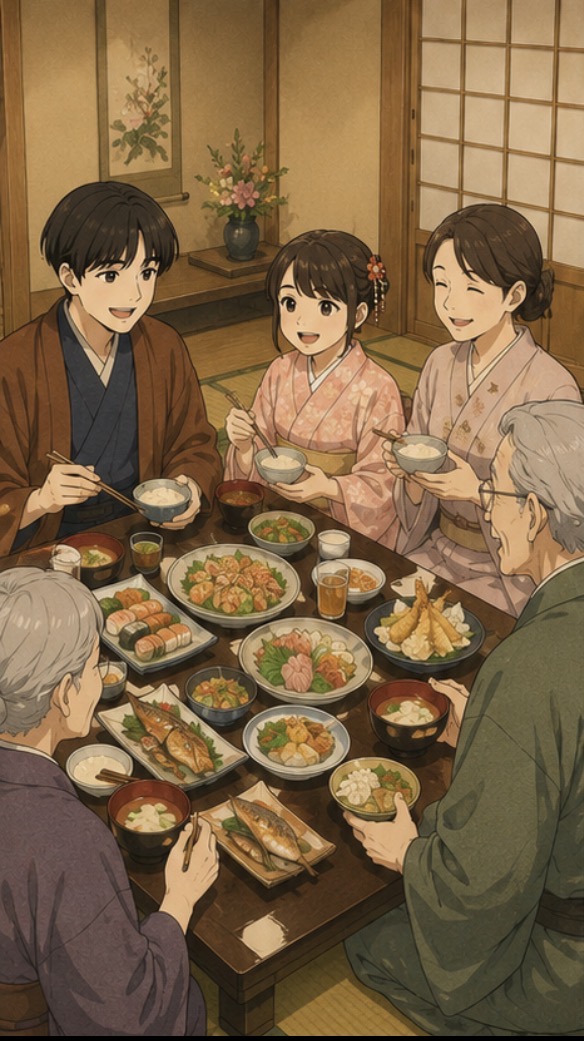
The emotional core of Obon is closer to a family reunion than a haunting. Ancestors aren’t feared during this period — they’re welcomed the way you’d welcome a beloved grandparent home for a holiday. The mukae-bi fires are lit with the same warmth as leaving a porch light on for someone you’re expecting. The food placed on the butsudan isn’t an offering meant to appease a restless spirit; it’s a plate set out because a family member is coming to visit, and of course you’d feed them.
This is also why Obon carries such strong emotional weight even for Japanese people who don’t consider themselves particularly religious or spiritual. It’s less about literal belief in an afterlife and more about a structured, culturally sanctioned time to remember, honor, and feel close to family members who have passed away — something many cultures don’t build a formal seasonal ritual around.
Kisei: Why Millions of People Travel Home During Obon
Because Obon is fundamentally about family, it naturally draws people back to where their family is — specifically, back to the ancestral hometown where the family grave and butsudan are located. This homecoming journey is called kisei (帰省).
In a country where many people move to major cities like Tokyo or Osaka for work or university, Obon becomes one of the few times a year when extended families reunite in one place — often a grandparent’s house in a smaller town or rural area.
The resulting travel surge, sometimes called the “Obon rush” (お盆ラッシュ), is one of the three biggest travel periods in Japan each year, alongside New Year (Oshogatsu) and Golden Week in spring. During the days surrounding August 13–16:

- Shinkansen and expressways see their heaviest congestion of the year, with some highway sections experiencing traffic jams tens of kilometers long.
- Domestic flights and long-distance trains sell out well in advance, especially routes connecting Tokyo, Osaka, and regional hometowns.
- Some small businesses, family-run restaurants, and local shops close for several days, as owners themselves travel home for Obon.
- Conversely, many small towns and rural areas come alive with local bon odori festivals, fireworks, and community events that are far less touristy and far more genuinely local than what you’d find in big cities.
How Travelers Can Respectfully Experience Obon
If your trip lands in mid-August, don’t think of Obon as bad timing — think of it as a rare window into something most tourists never see.
A few ways to experience it well:
- Book transportation and accommodation early. Shinkansen seats and hotel rooms in popular regions fill up fast during kisei season.
- Join a local bon odori. These community dances are almost always open to everyone, tourists included — you don’t need to know the steps in advance; just watch the circle for a few rounds and join in.
- Watch a send-off fire event if you can, like Kyoto’s Gozan no Okuribi, but arrive early and be mindful that for many people around you, this is a deeply personal, emotional moment, not a photo opportunity.
- Be patient with closures. If a small family restaurant or shop is shuttered in mid-August, it likely means the owners have gone home to be with their own ancestors and family — which, once you understand Obon, feels less like an inconvenience and more like a small window into what the season actually means.
Hazuki may have started as a quiet observation about falling leaves in an old lunar calendar. But centuries later, it’s become inseparable from a season when Japan, as a whole, pauses to welcome its ancestors home — and, if you’re visiting in August, it’s a season that welcomes you to witness that warmth too.


Leave a Reply