
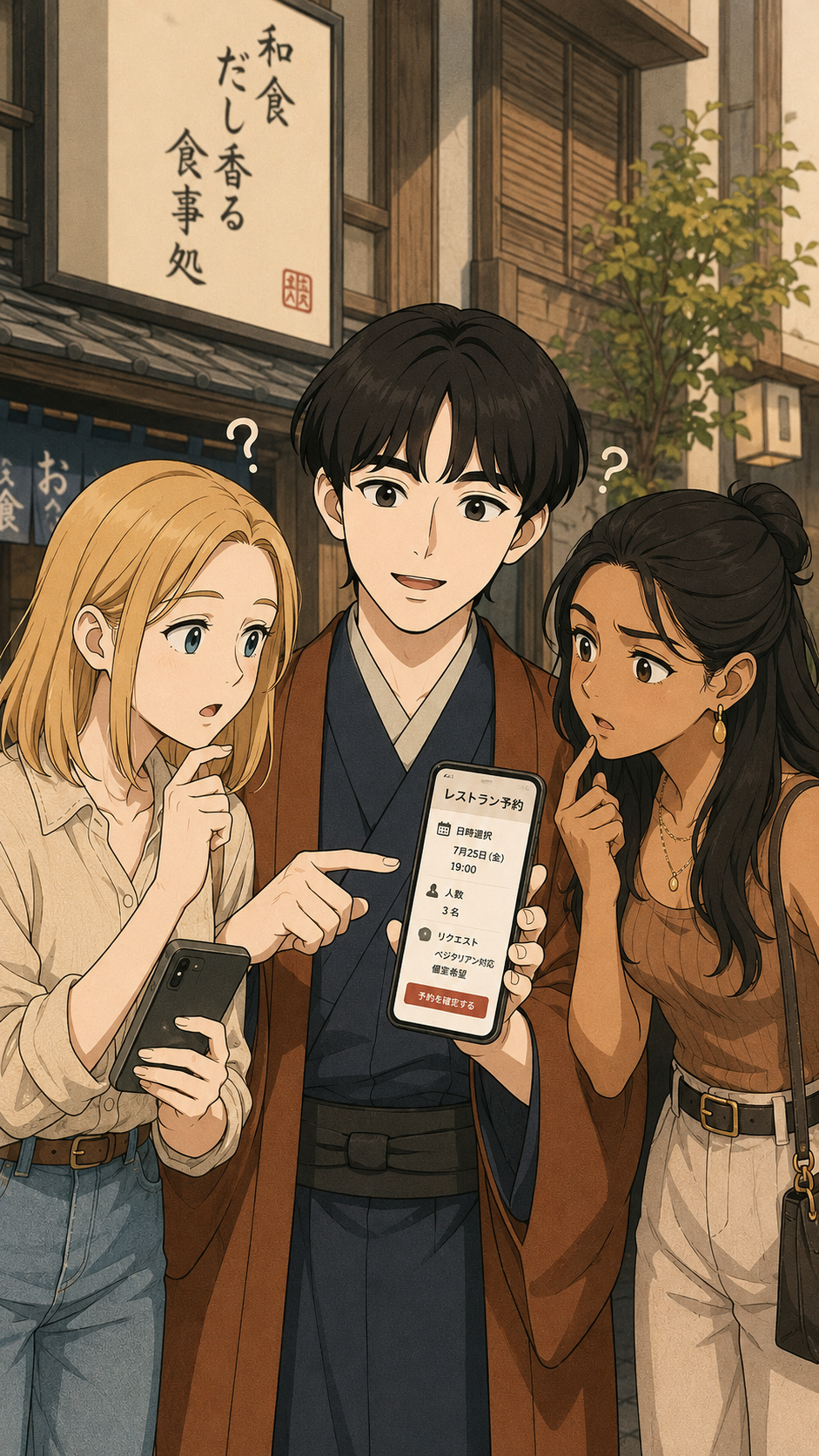
If you’ve spent any time researching where to eat in Japan, you’ve probably noticed something: the best places are almost always booked. Not because they’re chasing hype, but because they’re small, precise, and built around a rhythm that a walk-in crowd would break.
Before we get into the etiquette side of things, let’s start with the practical question every first-time visitor asks — how do I actually book a table in Japan?
The easiest way in for most travelers is through a reservation platform. Hot Pepper Gourmet (ホットペッパーグルメ) and Tabelog (食べログ) cover everything from casual izakaya to mid-range dining, and both have English-friendly search functions if you know where to look. For anything higher-end — omakase counters, kaiseki restaurants, ryokan dining — Ikkyu (一休.com) is the platform locals use, and it’s often the only way to secure a seat at the most exclusive spots.
Phone reservations are the harder route, and I’ll be honest with you: they’re not really designed for tourists. Most restaurants that still take calls expect fluent, polite Japanese, and a foreign accent on the other end can sometimes lead to a gentle “sorry, we’re full” even when there’s space. This is one of those situations where having a Japanese friend make the call for you — or asking your hotel concierge to do it — genuinely changes what’s possible. It’s not a workaround so much as a small window into how much relationships matter here.
Once you understand how to book, the more important thing to understand is what a booking actually means in Japan. A reservation isn’t just a line on a calendar. It’s closer to a quiet agreement between you and the restaurant — and that agreement carries more weight than most visitors expect.
One more practical note before we go further: many reservation platforms and restaurant sites are still Japanese-only, and English support varies a lot by region and restaurant type. In big cities like Tokyo, Osaka, and Kyoto, you’ll find a growing number of English-friendly booking pages, especially at restaurants used to international guests. In smaller towns, you may need a translation app, a hotel concierge, or a bit of patience. None of this should discourage you — it’s simply part of the texture of booking a table in a country where dining is treated as a craft, not a transaction.
Why Reservations Matter More in Japan Than Many Tourists Expect

In a lot of countries, a restaurant reservation is a convenience. In Japan, at many restaurants, it’s closer to a commitment the kitchen is already acting on before you arrive.
Small kitchens, limited seating. Many of the restaurants travelers dream about — an eight-seat sushi counter, a fourteen-seat kaiseki room — are built to serve a precise number of people, not a flexible range. There’s no back room absorbing extra guests. When a seat is booked, it’s genuinely accounted for.
Course preparation starts before you walk in. At omakase and kaiseki restaurants especially, ingredients are often sourced and prepped that morning, sometimes with your reservation in mind. A chef isn’t cooking for a general crowd — he’s cooking for the specific number of people on the list. A no-show doesn’t just leave a table empty. It leaves food that was already prepared for someone who never came.
Staff planning depends on the numbers. Smaller restaurants often schedule staff shifts around expected covers. A last-minute cancellation, especially for a group, can mean a member of staff worked a shift for nothing.
None of this is about rigidity for its own sake. It’s what allows Japanese hospitality to feel as calm and unhurried as it does — the preparation happens quietly, in advance, so the moment you sit down, everything can move smoothly.
Types of Reservations You’ll See
Not every restaurant in Japan requires advance planning, and part of traveling well here is knowing which is which.
Walk-in culture vs. reservation-only. Ramen shops, most izakaya, casual soba and udon spots, and neighborhood diners are usually walk-in friendly, sometimes with a short queue at peak hours. This is where spontaneity still works beautifully. Reservation-only restaurants tend to be the smaller, chef-driven spaces — sushi counters, kaiseki rooms, tasting-menu restaurants — where the whole experience is built around a fixed number of guests.
Omakase, kaiseki, and counter dining. These formats are almost always reservation-only, often weeks or months in advance for the most sought-after names. The counter seat isn’t just a table — it’s a relationship with the chef for the duration of the meal, which is part of why these restaurants guard their booking numbers so carefully.
Deposit or credit card hold. For higher-end reservations, especially through Ikkyu, it’s increasingly common to be asked for a deposit or a card on file. This isn’t a sign of distrust toward you personally — it’s a response to a real, ongoing no-show problem that’s become more visible as international bookings have grown. Think of it less as a barrier and more as the restaurant protecting its ability to keep serving everyone well.
Party size flexibility. It’s also worth knowing that many small restaurants — especially counter-style ones — have strict limits on party size and rarely make exceptions. If a restaurant says it seats a maximum of six, showing up with eight and hoping for the best usually isn’t an option, since there’s often no space to physically add seats. If your group grows or shrinks after booking, it’s always worth updating the restaurant rather than assuming it won’t matter.
What to Do If You’re Running Late

Life happens — trains get delayed, directions get confusing, the last shop you visited was more interesting than planned. What matters isn’t that you’re late; it’s how you handle it.
How much delay matters depends heavily on the restaurant. A fifteen-minute delay at a casual izakaya is barely worth mentioning. That same fifteen minutes at an eight-seat omakase counter can mean the chef’s timing for the first few courses is thrown off for everyone at the bar, not just you.
Why ten to fifteen minutes can change service. At counter-style restaurants, courses are often timed to be served at their best moment — rice at the right temperature, fish cut just before serving. A late arrival can force a chef to choose between rushing your neighbors’ meal or letting yours start behind.
A short message goes a long way. If you have the restaurant’s line on a messaging app, or a number you can call, even a brief message helps enormously:
“We are running about 15 minutes late, we’re so sorry. We are on our way now.”
You don’t need fluent Japanese for this — a short, polite message in English is understood far more often than travelers assume, and the gesture itself is what matters most.
Cancellation Etiquette

This is the part of Japanese dining culture that trips up even well-meaning travelers, mostly because the consequences aren’t visible from the guest’s side of the table.
Same-day cancellations are taken seriously almost everywhere, and at reservation-only restaurants they can be genuinely difficult for the business to absorb. If your plans change, letting the restaurant know as early as possible — ideally the day before — gives them a real chance to fill the seat.
No-show damage is the most serious version of this. Unlike a cancellation, a no-show gives the restaurant zero chance to react. The ingredients are used, the seat is empty, and in smaller restaurants, that loss is felt directly. This is a large part of why deposits have become more common in tourist-heavy areas over the past few years — not as a punishment, but as a practical response to a pattern that was hurting small, high-effort businesses.
What respectful travelers should do instead:
- Cancel as early as you possibly can, ideally 24–48 hours ahead for reservation-only restaurants
- Send a short, polite message rather than simply not showing up
- If you booked through a platform, cancel there and message the restaurant directly if you have contact info
- Treat a confirmed reservation the way you’d treat a commitment to a friend, not a placeholder you can quietly drop
None of this requires perfect Japanese or deep cultural fluency. It just requires treating the booking as real.
Allergies, Preferences, and Dietary Communication
Japanese kitchens, especially at the omakase and kaiseki level, are built around precision — which makes advance communication genuinely useful rather than a formality.
What to tell in advance: allergies, religious dietary restrictions, and strong dislikes are all worth mentioning at the time of booking, not at the table. Many high-end restaurants plan their entire course sequence around the guest list, sometimes days ahead.
Why last-minute changes are hard: if you mention a shellfish allergy after the chef has already prepped a course built around it, there often isn’t a backup plan sitting in the kitchen. Restaurants that know in advance can usually accommodate gracefully; restaurants surprised at the counter have far fewer options.
A simple note at the time of booking — through the platform, or a short message to the restaurant — is one of the easiest ways to make sure your meal actually reflects what you need. A message as plain as this is usually enough:
“Thank you for the reservation. One person in our group has a shellfish allergy. Is it possible to adjust the course? Thank you very much.”
Restaurants that plan ahead almost always appreciate the heads-up far more than they mind the request itself.
The Bigger Meaning: Trust and Respect
It would be easy to read all of this as a list of rules, but that misses the point a little. This is not strictness for strictness’s sake. The care Japan puts into reservations exists because the food, the service, and the experience are all built on trust between a small number of people — the chef, the staff, and you.
It protects quality and hospitality, not just for you, but for everyone who books after you. A restaurant that can trust its guests to show up, communicate, and respect the process is a restaurant that can keep offering the kind of quiet, effortless-feeling hospitality Japan is known for. Every time a traveler treats a reservation with real respect, it makes it a little easier for the next traveler to be welcomed in, too.
That’s really what this comes down to. Booking a table in Japan is a small act of trust in both directions. Honor it, and you become the kind of guest restaurants remember — not because you did anything remarkable, but because you simply kept your word.

Planning to book restaurants during your trip to Japan? Save this guide before you start reserving tables — a little preparation goes a long way toward being the kind of traveler Japan loves to welcome back.


Leave a Reply